
Video Localization guide for Content Creators
The Complete Guide to Reaching a Global Audience
Expand your audience, increase watch time, and build a truly international content brand through professional video localization.
Video localization helps content creators reach international audiences by adapting videos for different languages and cultures through subtitles, voice-over, or dubbing. When done well, localization preserves the original viewing experience while making content feel natural to viewers around the world, creating new opportunities for audience growth, engagement, and revenue.
Table of Contents
Your Next Million Viewers May Not Speak Your Language
Imagine opening your YouTube Analytics tomorrow morning and noticing that one of your videos is suddenly gaining thousands of views from countries you’ve never targeted before. Your subscriber count is growing, your watch time is increasing, and comments are arriving in languages you don’t speak.
- At first, it feels exciting.
- Then curiosity turns into opportunity.
How many more people could enjoy your content if language were no longer a barrier?
That question sits at the heart of this guide. Most of those new viewers can enjoy only a small portion of your content because it wasn’t created for them.This situation is becoming increasingly common.
Content platforms such as YouTube, TikTok, Facebook, Instagram, and streaming services are no longer limited by national borders. Recommendation algorithms care less about where a creator lives and more about whether viewers find the content engaging. As a result, creators are discovering audiences far beyond their home countries. For many creators, this changes an important assumption.
For the first time in history, a creator’s audience is no longer defined by geography—it is increasingly defined by language. Which means your future growth may depend on how effectively you communicate with people who don’t speak yours. And for many creators, that opportunity is much closer than they realize. This is where video localization becomes one of the most powerful long-term growth strategies available to content creators. For years, localization was primarily associated with major film studios, television networks, and global streaming platforms. Dubbing and multilingual production required substantial budgets, large production teams, and complex workflows that were out of reach for most independent creators.
Today, that landscape looks completely different.
Advances in production technology, cloud collaboration, artificial intelligence, and remote recording have made professional localization accessible to organizations of almost every size. Independent YouTubers, educators, documentary producers, podcasters, online course creators, software companies, and businesses can now reach audiences that were once impossible to serve economically.
Despite these changes, many creators still think of localization as simply “translating a video.”
In reality, it is much more than that. Successful localization preserves your message, your personality, your storytelling style, and your brand while making your content feel natural to viewers from another language and culture.The goal isn’t simply to help people understand your content. The goal is to make them feel as though it was created for them. That distinction often determines whether a localized video merely attracts views or builds loyal subscribers. Throughout this guide, you’ll learn:
- What video localization actually involves.
- Which creators benefit most from localization.
- How to choose the right languages.
- When subtitles are enough—and when professional dubbing creates greater value.
- How artificial intelligence is changing the localization industry.
- How successful creators build scalable multilingual content strategies.
By the time you finish this guide, you’ll have a practical framework to evaluate whether your content is ready for localization, identify the most promising international markets, choose the right localization method, avoid common mistakes, measure success effectively, and build a roadmap for growing your audience beyond the borders of your native language.
Whether you’re running a small educational channel or managing a growing media brand, this guide will help you understand how localization fits into a sustainable international growth strategy—and how it can become one of the most valuable long-term investments in the future of your content.
How to Use This Guide
This guide is designed to take you from understanding the fundamentals of video localization to building a practical international growth strategy.
While the chapters are organized in a logical sequence, each chapter is also designed to stand on its own, so you don’t have to read the guide from beginning to end. If you’re looking for answers to a specific question, feel free to jump directly to the chapter that’s most relevant to your current needs.
Some chapters focus on helping you make strategic decisions, while others provide practical guidance on workflows, costs, and implementation. The final two chapters—Video Localization FAQ and Your Video Localization Roadmap—are designed as reference resources that you can return to whenever new questions arise, or you’re ready to take the next step.
Wherever you are in your creator journey, this guide is designed to help you make informed decisions, avoid costly mistakes, and build a localization strategy that supports sustainable long-term growth.
Chapter 1: What Is Video Localization?
A Complete Guide for Content Creators
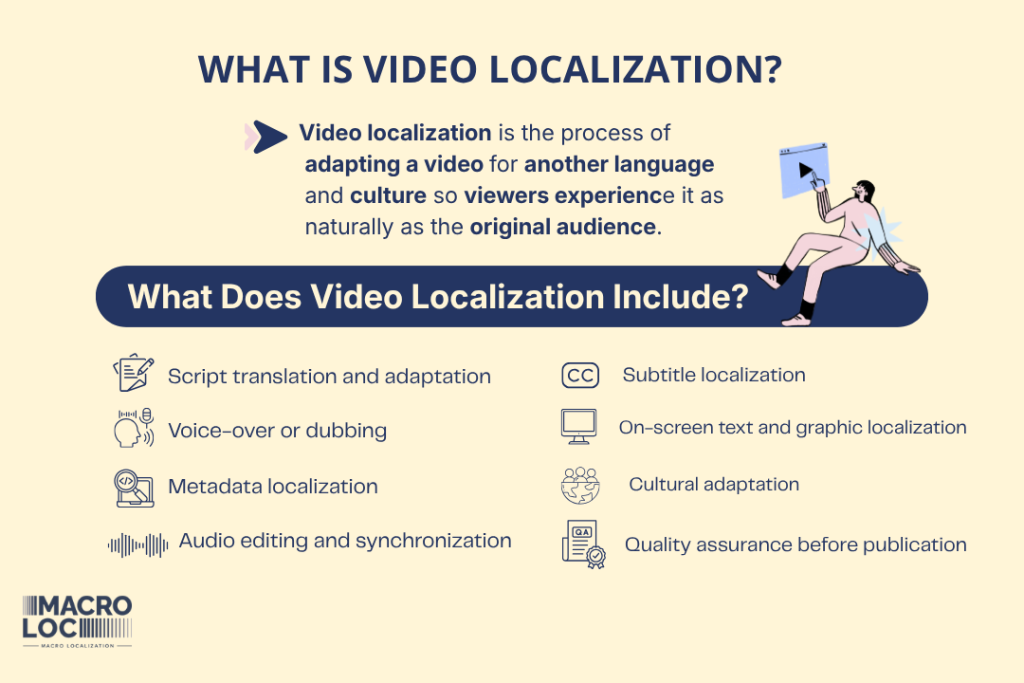
Video localization is the process of adapting a video for another language and culture so viewers experience it as naturally as the original audience. Unlike simple translation, video localization may include subtitles, voice-over, dubbing, script adaptation, on-screen text localization, metadata optimization, and cultural adaptation to create an authentic viewing experience for a global audience.
If you ask ten content creators what video localization means, many will answer with a single word: Translation.
While translation is certainly part of the process, it represents only one piece of a much larger picture. Successful video localization is not about replacing one language with another. It is about recreating the same emotional, educational, and entertainment experience for viewers who speak a different language. The goal is for your audience to feel that the content was created specifically for them—even if the original video was produced on the other side of the world.
Video Localization vs. Video Translation: What’s the Difference?
One of the biggest misconceptions among content creators is that video translation and video localization mean the same thing. They don’t. Translation focuses on converting words from one language into another. Its primary goal is linguistic accuracy. Localization goes much further. It adapts your content so it feels natural within another language and culture while preserving your message, storytelling style, personality, and brand identity. The difference may seem subtle, but it has a significant impact on how audiences experience your content.
Video Translation | Video Localization |
Converts language | Adapts the complete viewing experience |
Focuses on words | Focuses on the audience |
Usually limited to text or dialogue | May include subtitles, dubbing, voice-over, graphics, metadata, and cultural adaptation |
Preserves meaning | Preserves meaning, emotion, tone, and brand identity |
For creators who want to build multilingual content and reach international viewers, localization provides a far more effective long-term strategy than translation alone.
What Does Video Localization Include?
Depending on your goals, target audience, and distribution platform, a professional localization project may include:
- Script translation and adaptation
- Subtitle localization
- Voice-over or dubbing
- On-screen text and graphic localization
- Metadata localization, including titles and descriptions
- Cultural adaptation where appropriate
- Audio editing and synchronization
- Quality assurance before publication
Not every project requires every service. Some creators only need professionally localized subtitles, while others invest in full dubbing to create a native-language viewing experience. The right approach depends on your audience, content type, growth strategy, and available budget—topics we’ll explore in later chapters.
Think About How You Produce Your Own Videos
Think about the process of creating one of your own videos. Long before your audience clicks the play button, your content has already gone through dozens of production stages. You research the topic, write a script, prepare equipment, record footage, edit the video, improve the audio, add music, create graphics, color grade the visuals, design a thumbnail, optimize the title and description, and finally publish it. Your viewers rarely think about any of those individual steps. They simply enjoy the finished video. Professional video localization works in much the same way.
Once you decide to localize your videos, an experienced localization team manages the entire production workflow for you. Depending on your goals, target audience, budget, and chosen markets, that workflow may include translating and adapting the script, selecting native voice talent, recording and editing audio, creating subtitles, localizing on-screen graphics, optimizing metadata for the target market, and performing multiple quality checks before the final version is delivered.
The important thing is that these are not separate tasks that you need to organize yourself. They are coordinated stages within a proven production workflow—just as research, filming, editing, sound design, and thumbnail creation all come together to produce a professional video.
Your Role Doesn’t Change
As a creator, your role doesn’t change. You continue doing what you do best: creating great content. The localization team’s role is to make that content feel as though it was originally created for viewers in another language. Whether your goal is to reach new YouTube audiences, grow an international brand, or build multilingual content across several markets, successful localization allows you to expand your reach without changing what makes your content unique. Understanding what video localization is is only the first step. The bigger question is why so many creators—from independent YouTubers to global media companies—are investing in localization today.
In the next chapter, we’ll explore the forces driving this shift and why video localization has become one of the most effective strategies for international audience growth.
Learn More About the Video Localization Workflow
Curious about what happens after you decide to localize your content?
Our companion guide, Understanding the Video Localization Workflow: From Translation to Final Delivery, explores every stage of a professional localization project—from preparing source files and adapting the script to voice casting, recording, quality assurance, and final delivery. If you’d like a behind-the-scenes look at how multilingual video projects are managed, that guide walks you through the entire process.
Chapter 2: Why Is Video Localization Important?
How Content Creators Reach Global Audiences
Video localization has become one of the most effective ways for content creators to reach international audiences without constantly producing new content. As YouTube, streaming platforms, and social media increasingly recommend videos across borders, language—not geography—has become the biggest barrier to global growth.
Until recently, most content creators shared one obvious goal: build an audience that spoke the same language they did. Whether you were producing educational videos, documentaries, cooking tutorials, or technology reviews, your primary competition—and your primary audience—were people in your own market. International expansion was something reserved for major media companies with the budgets to translate, dub, and distribute content around the world. Today, that distinction has largely disappeared. A creator no longer needs an international media company to build an international audience. A documentary produced in Canada can find viewers in Brazil. A programming tutorial created in India can help students in Germany. A history channel based in the United Kingdom can build loyal communities across the Middle East. The internet didn’t simply make global distribution possible.
It made it automatic. Modern recommendation algorithms no longer ask where your content was created. Instead, they ask a much simpler question:
Will someone enjoy watching this?
If the answer is yes, your video may be recommended to viewers thousands of miles away—regardless of language, culture, or geography. For creators, this represents one of the greatest opportunities in the history of online content. But it also introduces a new challenge. Your content can now reach people who are genuinely interested in your topic but unable to fully understand your message.
Language has become the last major barrier to international growth.
Why Video Localization Is Important
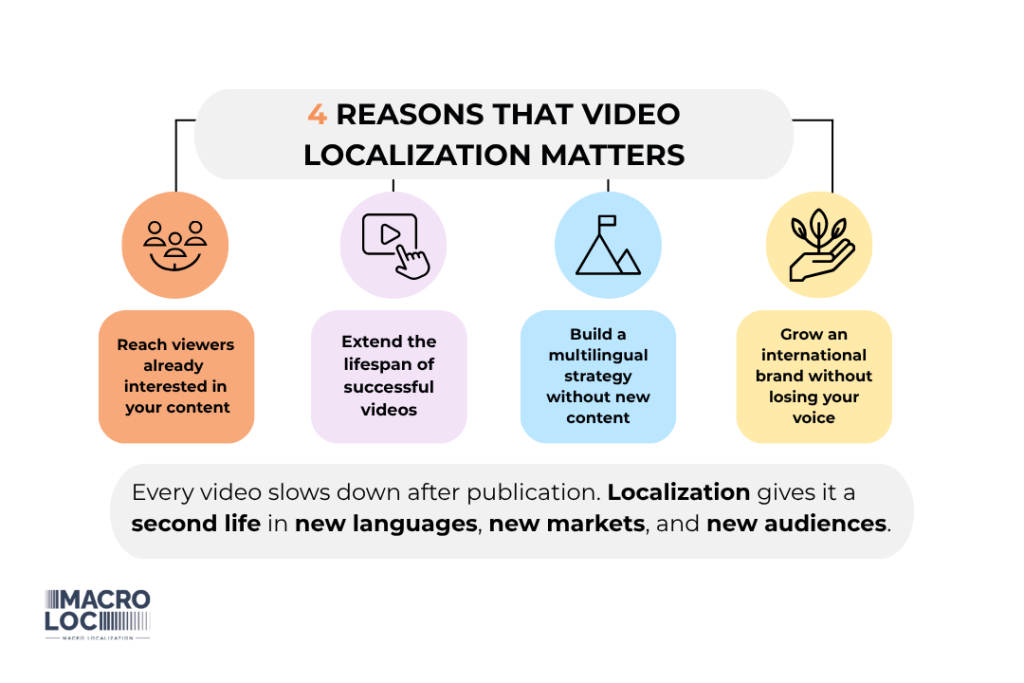
For creators, removing that language barrier creates opportunities that simply didn’t exist a few years ago. Professional video localization helps you:
- Reach international viewers who are already interested in your content.
- Extend the lifespan of successful videos by introducing them to new markets.
- Build a multilingual content strategy without constantly creating new videos.
- Grow an international brand while preserving your unique voice and identity.
Rather than replacing your existing content strategy, localization allows you to multiply the value of the content you’ve already created.
The Rise of Global Content Consumption
Audience behavior has changed dramatically over the past decade. Viewers have become increasingly comfortable discovering creators, brands, and media companies outside their own countries. Streaming platforms have introduced millions of people to international films and television series. Social media platforms continuously recommend videos from creators around the world. Educational content is shared globally within minutes of being published. Today, audiences increasingly choose content based on its value—not its country of origin. As audiences become more international, creators have an opportunity to think internationally as well. Instead of asking:
“What should I create next?”
many successful creators are beginning to ask a different question:
“Who else could benefit from what I’ve already created?”
Sometimes, the answer isn’t creating more content. It’s making existing content available in another language.
How Video Localization Extends the Life of Your Content
Every video has a natural life cycle. After publication, it attracts viewers, generates engagement, and eventually reaches a plateau. Video localization can extend that life cycle by introducing the same content to entirely new audiences. Instead of starting from zero, creators can build on work they’ve already completed. A single well-performing video may continue generating value across multiple languages, regions, and audiences for years after its original release.
For channels built around evergreen content—such as education, documentaries, business, technology, science, or personal development—this can become one of the most efficient ways to grow internationally.
Why Successful Creators Invest in Video Localization
The creators who succeed internationally don’t think of localization as a production expense. They think of it as a strategic investment. Just as creators invest in better cameras, stronger editing, improved storytelling, and search optimization, they increasingly view localization as another investment in expanding their audience. The goal isn’t simply to publish videos in more languages. The goal is to build a brand that audiences around the world feel was created for them. For many creators, that’s the difference between building a successful local channel and building a truly global one. Localization is no longer just a way to translate content.
For creators with international ambitions, it has become one of the most effective strategies for extending the value of existing content, reaching new audiences, and building a brand that can grow beyond language barriers. Understanding why video localization is important is only part of the decision. The next question is more personal:
Is your own channel actually ready for localization?
In the next chapter, we’ll explore the signs that indicate when localization can become a worthwhile investment—and when it may be better to wait.
Chapter 3: Is Your Channel Ready for Video Localization?
How to Know When It’s Time to Reach International Audiences
Not every content creator should localize their videos immediately—and that’s perfectly normal. The right time to expand into new languages depends less on subscriber count and more on whether you’ve built a consistent content strategy, created content with long-term value, and identified opportunities to reach international audiences.
By now, you may be wondering whether video localization is the right next step for your channel. The answer depends less on the size of your audience and more on the maturity of your content strategy and your long-term goals. One of the most common misconceptions is that localization is only worthwhile for creators with millions of subscribers. In reality, there is no universal subscriber count, view threshold, or revenue milestone that determines when a creator should begin thinking about international audiences. Every channel is different, which is why the decision should be based on strategy rather than size. The real question is whether your channel has reached a stage where expanding into new languages makes strategic sense.
If you’re still experimenting with different content formats, changing your niche frequently, or trying to understand what resonates with your audience, your time is probably better spent refining your core content. On the other hand, if you’ve established a clear direction and consistently produce content that delivers value, localization may become a natural next step in your channel’s growth.
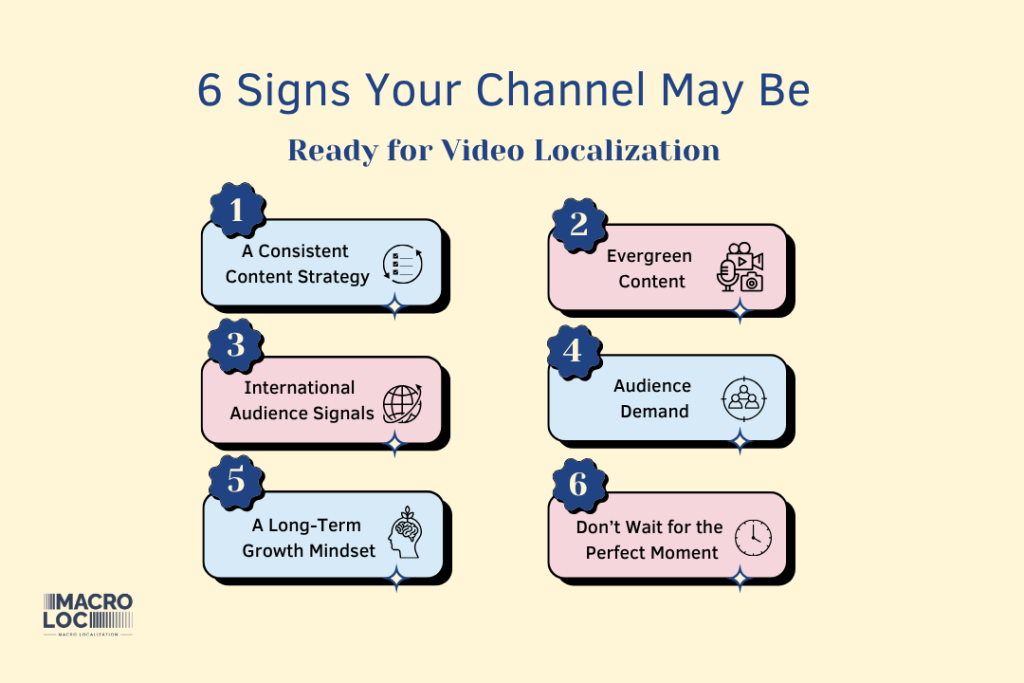
Signs Your Channel May Be Ready for Video Localization
There isn’t a single subscriber milestone, view count, or revenue target that tells you it’s time to localize your content. Instead, successful creators usually share several common characteristics. Think of the following six indicators as a readiness checklist. You don’t need to check every box before localizing your content. However, the more of these indicators your channel meets, the greater the likelihood that video localization will become a worthwhile strategic investment.
1. A Consistent Content Strategy
Creators who publish consistently usually benefit the most from localization. A regular publishing schedule not only helps grow your primary audience but also creates a sustainable workflow for expanding into additional languages over time. Localization works best when it becomes part of an ongoing content strategy rather than a one-time experiment.
2. Evergreen Content
Some videos attract attention for only a few days before their performance declines. Others continue receiving views months—or even years—after publication. These evergreen videos are often ideal candidates for localization because they continue creating value long after they are released. Rather than starting from scratch, localization allows you to extend the reach of content that has already proven its value.
3. International Audience Signals
One of the best places to identify localization opportunities is YouTube Analytics (or the analytics platform you use).
If viewers from countries where your language isn’t widely spoken are already discovering your content, it may indicate that language—not interest—is the primary barrier preventing further growth.
Even a relatively small percentage of international viewers can reveal opportunities worth exploring.
4. Audience Demand
Sometimes your viewers will tell you exactly what they want. Comments such as:
- “Can you add Spanish subtitles?”
- “Is this available in Arabic?”
- “Please dub this into Portuguese.”
are valuable signals that people want to enjoy your content—or share it with friends and family who speak another language. Listening to your audience is often one of the simplest ways to identify potential markets.
5. A Long-Term Growth Mindset
Localization is rarely about immediate results. It’s an investment in the future of your content library and your brand. Creators who see their channel as a long-term project often gain the greatest value because every localized video becomes another asset that can continue reaching new audiences for years to come.
6. Don’t Wait for the Perfect Moment
Many creators delay localization because they believe they need to reach one more milestone before expanding internationally. One more thousand subscribers. One more viral video. One more year of growth. In reality, there is no perfect moment. Some creators begin experimenting after a handful of successful videos, while others wait until they have built an extensive library of evergreen content. Both approaches can succeed. What matters most is not how large your channel is today, but whether you’ve built a strong foundation, developed a consistent content strategy, and have a genuine ambition to reach audiences beyond your current language. If those conditions are already in place, your channel may be more ready than you think. Determining whether your channel is ready is only part of the decision. The next question is equally important:
Does your content actually have international potential?
Even if your channel is ready to expand, not every type of content is equally suited for localization. In the next chapter, we’ll explore why some types of content naturally connect with global audiences while others are best served by staying focused on their local market.
Chapter 4: What Makes a Video Worth Localizing?
How to Identify Content with Global Potential
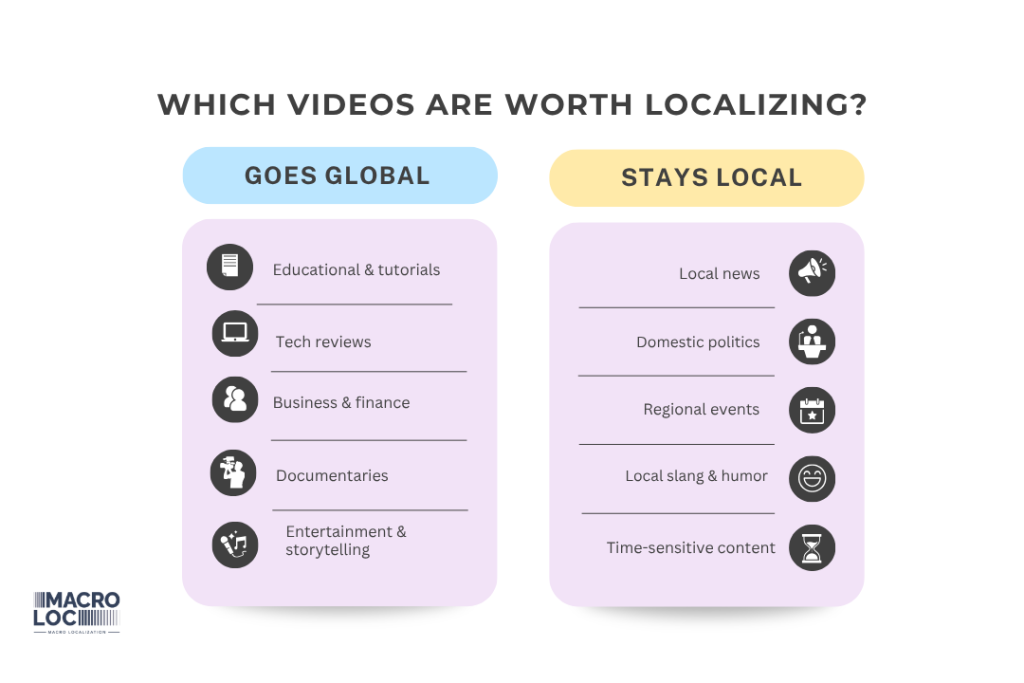
Not every video is worth localizing. The best candidates are videos with long-term value, universal appeal, and audiences that exist beyond your native language. In this chapter, you’ll learn how to identify videos with global potential, recognize the types of content that perform well internationally, and decide which videos should be localized first to maximize your return on investment.
Even if your channel is ready for localization, that doesn’t necessarily mean every video is. Many creators assume that once their channel is ready for localization, every video should be translated or dubbed. In reality, some videos have strong international appeal while others are better suited to local audiences. Knowing which videos to localize first can save money, maximize your return on investment, and produce far better long-term results. Before investing in video localization, there is another important question to answer. It has nothing to do with your subscriber count, production quality, or budget. Instead, ask yourself a much simpler question:
If language were no longer a barrier, would people in other countries still find my content valuable?
That question lies at the heart of every successful localization strategy. The answer often determines whether localization becomes a worthwhile long-term investment—or an unnecessary expense. Many creators assume that if a video can be translated, it should be translated. In reality, being translatable and having international potential are two very different things. Technically, almost any video can be translated into another language. Strategically, however, not every video is worth localizing. The goal of localization is not simply to make content understandable in another language. The goal is to introduce valuable content to audiences who are genuinely interested in it. When international demand exists, localization removes the language barrier. When that demand doesn’t exist, translation alone cannot create it.
Content with High International Potential
Some topics naturally appeal to people regardless of where they live because they solve universal problems, answer common questions, or provide entertainment that crosses cultural boundaries. Educational videos, tutorials, documentaries, technology reviews, science, business, finance, personal development, history, health, true crime, children’s content, travel, and many forms of entertainment often have strong international potential. People everywhere want to learn new skills, understand the world around them, solve problems, hear compelling stories, or simply be entertained. Educational and tutorial videos perform well internationally because people around the world search for the same knowledge and practical solutions. A programming lesson, language course, or photography tutorial can be just as useful to someone thousands of miles away as it is to viewers in the creator’s home country.
Technology reviews often compare products that are sold globally, making them relevant to audiences across multiple markets. Likewise, business, finance, and personal development channels frequently discuss challenges that entrepreneurs, professionals, and students face regardless of where they live. What these topics have in common is that the problems they solve and the stories they tell are not limited by geography. For these creators, language is often the biggest obstacle separating their content from a much larger audience.
Content Closely Tied to a Local Audience
Other types of content are built around local experiences, current events, or cultural context. That doesn’t make them less valuable. Their value is simply more closely connected to a particular place, culture, or moment in time. Examples include:
- Local news and current affairs
- Domestic politics
- Neighborhood events
- Regional regulations and public services
- Local sports coverage
- Community-focused discussions
- Content centered around local celebrities or public figures
- Highly time-sensitive events
- Humor that depends heavily on local slang or cultural references
- Videos discussing everyday habits, traditions, or social issues that are unique to a particular country or region
Many of these channels attract millions of subscribers because they provide tremendous value to their local communities. However, that same value may not translate into international interest. For example, a daily news channel covering municipal issues in one city may be extremely successful, yet viewers in another country are unlikely to follow those stories simply because they are available in their own language. Likewise, a creator discussing the latest social trends, television personalities, or political debates within one country may have an incredibly loyal audience without necessarily having a global audience waiting to discover that content.
In these cases, the limitation isn’t the language. It’s the relevance of the topic itself. A video can be highly successful without having international potential. If viewers watch your content because it reflects their local culture, daily lives, regulations, or current events, localization may add little value because interest—not language—is the real limitation.
Start with Your Best Videos
One of the biggest mistakes creators make is assuming they need to localize their entire video library from the very beginning. In most cases, that’s unnecessary. Instead, start with the videos that have already proven themselves. Evergreen videos that continue attracting views months or even years after publication are often the safest investment because they’ve already demonstrated lasting value. Localization allows you to multiply the reach of content that is already working instead of gambling on videos that haven’t yet found an audience. Many creators begin by localizing just five or ten of their strongest-performing videos before gradually expanding their multilingual content library.
This approach reduces risk, provides valuable insights about international audiences, and helps you make better localization decisions as your channel grows.
International Potential Checklist
Before deciding to localize a video, ask yourself these five questions:
- Would people outside my country search for this topic?
- Does this video solve a problem or answer a question that people around the world share?
- Will this content still be useful or relevant six months—or even a year—from now?
- Does the video’s value depend heavily on local culture, regulations, or current events?
- If language disappeared tomorrow, would people in other countries still want to watch it?
The more often your answer is yes, the greater your content’s international potential is likely to be.
Localization Doesn’t Create International Demand
One of the biggest misconceptions about localization is that translation alone can make content successful.
It can’t. Localization is not a shortcut to international growth, nor is it a replacement for creating valuable content. Instead, it removes one of the final barriers between great content and the audiences who are already interested in it. That’s why we encourage creators to think about localization as a growth strategy rather than simply a translation service. The most successful international creators don’t localize everything they publish.
Instead, they identify the videos with the greatest international potential and invest where localization can deliver the greatest long-term return. Rather than asking,
“Can this video be translated?”
successful creators ask a better question:
“Would this video still provide value to someone on the other side of the world?”
If the answer is yes, localization becomes a powerful way to connect with an audience that already exists—you simply haven’t reached them yet. By now, you’ve evaluated both your channel and your content. The next step is understanding which localization approach is the right fit for your goals. Different types of content—and different audiences—often require different localization strategies.
In the next chapter, we’ll explore the most common localization methods, when each one works best, and how to choose the approach that delivers the greatest value for your content.
Chapter 5: Why Some Videos Perform Better Internationally
What Makes Content Travel Across Languages and Cultures
Some types of content naturally perform better across languages because they solve universal problems, tell compelling stories, or appeal to audiences regardless of where they live. In this chapter, you’ll discover why certain videos have greater international potential, which content categories are most suitable for localization, and what makes viewers around the world connect with your content.
One of the biggest misconceptions about international content is that only a handful of niches can succeed across languages. In reality, audiences around the world consume an extraordinary variety of content every day. They watch documentaries produced on another continent, learn recipes from foreign chefs, follow technology reviewers from different countries, enjoy Korean dramas, listen to American podcasts, and watch educational videos created by people they’ve never met—and may never meet. What these creators have in common isn’t their niche.
It’s the value they deliver. The most successful international creators usually share one important characteristic:
Their content solves problems, answers questions, tells compelling stories, or creates experiences that people can relate to regardless of where they live. The more universal the value, the greater the opportunity for international growth. International success rarely depends on the topic itself. It depends on whether the value your content provides can cross cultural and geographic boundaries. Let’s explore the types of content that consistently perform well across languages—and, more importantly, understand why they do.
Your Niche Matters Less Than You Think
Many creators spend too much time wondering whether they’re in the “right” niche for international growth. In reality, almost every niche has creators who have successfully reached audiences around the world. What separates them isn’t necessarily the subject they cover—it’s how much value they provide. A gardening channel can teach techniques that work almost anywhere. A woodworking creator can inspire viewers on another continent. A fitness coach can help people improve their health regardless of where they live. Even highly specialized topics can attract international audiences if they solve meaningful problems or satisfy genuine curiosity.
Rather than asking, “Is my niche international?”, ask yourself a better question:
“Would someone who speaks another language still find this content valuable?”
If the answer is yes, your niche may have more international potential than you think.
Knowledge and Educational Content
Some of the strongest candidates for localization are videos that help people learn, improve, or solve problems. Whether the subject is science, mathematics, language learning, programming, photography, engineering, business, marketing, personal development, creative skills, or AI, people everywhere are looking for reliable information that helps them accomplish something. Knowledge rarely depends on national borders. Someone learning Python in Brazil faces many of the same challenges as someone learning it in Germany or Japan. A photography tutorial recorded in Canada can help a beginner in Egypt just as easily as one in Australia. Business and professional education often follows the same pattern. Entrepreneurs, freelancers, managers, and professionals around the world face remarkably similar questions:
- How do I grow my business?
- How do I negotiate better?
- How can I improve productivity?
- How should I market my products?
Although certain financial advice depends on local regulations or tax laws, broader business principles often apply across many countries.
Why it works internationally: The language may change, but the problems—and often the solutions—remain the same.
Stories That Connect Across Cultures
Stories are one of humanity’s oldest forms of communication. Long before the internet connected the world, people shared stories across cultures because curiosity is universal. Today, documentaries about history, archaeology, science, psychology, economics, wildlife, technology, or extraordinary human experiences continue to attract audiences from every corner of the globe. The same is true for storytelling formats such as true crime, biographies, investigative journalism, historical narratives, and human-interest stories. A compelling story remains compelling regardless of the language in which it is told.
Why it works internationally: Great stories connect people through curiosity, emotion, and shared human experiences.
Technology and Product Reviews
Technology doesn’t recognize national borders. When people research a new smartphone, camera, AI tool, software application, SaaS platform, productivity app, or piece of equipment, they often watch reviews from multiple countries before making a purchasing decision. The products are usually the same. The questions people ask are often the same. The only difference is the language. This is why technology creators frequently discover that viewers from many different countries are already watching their content—even before localization begins. Once language is no longer a barrier, recommendation algorithms can introduce these videos to an even larger global audience that is already searching for the same products and solutions. Why it works internationally: Global products naturally create global audiences.
Children’s Content
Children’s programming has always been one of the world’s largest localization markets. Young audiences naturally prefer to watch content in their native language, making dubbing particularly valuable for this category. Animated series, educational cartoons, songs, bedtime stories, learning videos, and family entertainment often achieve remarkable international success because their themes are easy to understand and universally appealing.
Depending on the production, localization may also involve adapting on-screen text, graphics, educational materials, or visual references to make the experience feel natural for young viewers. Why it works internationally: Children everywhere enjoy stories, music, learning, and colorful characters—but they understand them best in their own language.
Culture, Travel, and Discovery
Travel and food channels occupy an interesting position. At first glance, they appear highly local. In reality, they often introduce viewers to places, traditions, cultures, and experiences they would never encounter otherwise. A cooking tutorial may teach a traditional regional recipe while inspiring viewers around the world to explore a new cuisine. A travel documentary filmed in Morocco may fascinate audiences in Brazil. A walking tour through Tokyo may attract viewers from Germany. Here, the local subject matter actually becomes part of the international appeal.
Why it works internationally: Curiosity about other people, places, and cultures is universal.
Entertainment Is More Universal Than You Think
Entertainment doesn’t always require universal subjects. It requires universal emotions. Humor, suspense, inspiration, competition, romance, surprise, excitement, and emotional storytelling can connect with audiences almost anywhere. While some comedy depends heavily on local language or cultural references, many forms of entertainment translate remarkably well when thoughtfully adapted for another audience.
Viewers rarely become emotionally invested because a story comes from a particular country. They become invested because they recognize ambition, fear, hope, curiosity, friendship, love, competition, or personal struggle. Those emotions exist in every culture. This is one of the reasons television series, feature films, documentaries, reality shows, animation, web series, and digital entertainment are localized into dozens of languages every year. Consider how audiences around the world enjoy Korean dramas, Spanish crime series, Japanese anime, British documentaries, or American reality shows. Most viewers aren’t watching because the content comes from a particular country—they’re watching because the stories, characters, conflicts, and emotions resonate with them. The same principle applies to independent creators.
A compelling challenge video, an inspiring personal journey, an engaging social experiment, a fascinating true crime documentary, or a well-produced adventure series can often attract viewers far beyond its country of origin once the language barrier is removed. The production budget may be different. The platform may be different. But great storytelling has always traveled well.
Why it works internationally: Emotion is one of the few languages that every audience already understands.
International Value Checklist
Instead of asking whether your channel belongs to the “right” niche, ask yourself these questions:
- Would someone in another country search for this topic?
- Does my content solve a universal problem or answer a common question?
- Does it tell a story or create an experience people everywhere can enjoy?
- Could this video still provide value months or years from now?
- Does its success depend heavily on local culture, language, or current events?
The more often your answer is yes, the greater your content’s international potential is likely to be. Ultimately, audiences don’t search for videos because they come from a particular country. They search because those videos educate them, entertain them, inspire them, or help them solve a problem. Language determines whether people can access your content. The value you create determines whether they stay.
By now, you’ve identified whether your channel is ready for localization and whether your content has the potential to resonate with international audiences. The next step is deciding how to localize it. Different types of content—and different audiences—often benefit from different localization approaches. In the next chapter, we’ll compare subtitles, voice-over, professional dubbing, and AI-assisted localization workflows to help you choose the approach that best fits your content, your audience, and your goals.
Chapter 6: How to Choose the Right Video Localization Method
Subtitles, Voice-Over, or Dubbing?
Choosing the right video localization method is about more than budget. Subtitles, voice-over, and professional dubbing each create a different viewing experience and are suited to different types of content. In this chapter, you’ll learn the strengths of each approach, when each method works best, and how to choose the one that fits your audience, your content, and your long-term growth strategy.
Once you’ve decided that your content has international potential, the next question is obvious:
- How should you localize it?
- Should you add subtitles?
- Record a voice-over?
- Or invest in professional dubbing?
There isn’t a single answer that works for every creator. The right choice depends on several factors, including the type of content you produce, the expectations of your audience, your budget, and—perhaps most importantly—the viewing experience you want to create. The answer isn’t about choosing the most advanced technology. It’s about choosing the experience that best serves your audience. Rather than asking which localization method is “best,” it’s more useful to ask:
Which method is best for my content and my audience?
Let’s explore the three most common approaches.
Subtitles: The Simplest Way to Reach New Audiences
For many creators, subtitles are the first step toward international growth. They preserve the original voices, emotions, and performances while making the dialogue understandable to viewers who speak another language. Subtitles are particularly effective for creators who want to expand into new markets without changing the original viewing experience. They also improve accessibility for viewers who prefer or need to read along, and multilingual subtitles can help creators test new international markets before making a larger localization investment. Subtitles are often an excellent choice for:
- Educational videos
- Tutorials
- Interviews
- Podcasts
- Business presentations
- Conference talks
- Documentary interviews
For many creators, subtitles are also the most practical way to evaluate audience interest before investing in voice-over or dubbing. However, subtitles do require viewers to divide their attention between reading and watching. For content with fast editing, complex visuals, or emotionally driven storytelling, this can sometimes reduce immersion and audience engagement.
Best suited for: Informational content where preserving the original speaker is an important part of the viewing experience.
Voice-Over: Balancing Authenticity and Accessibility
Voice-over replaces the spoken language while allowing the original speaker to remain audible beneath the translated narration. This approach is widely used in documentaries, interviews, educational videos, YouTube explainers, corporate communication, museum content, factual programming, and company presentations. Many viewers appreciate hearing the original speaker while simultaneously understanding the translated narration.
Voice-over provides a natural balance between preserving the authenticity of the original speaker and making the content easier for international audiences to follow. Compared with subtitles, viewers spend less time reading. Compared with dubbing, the original performance remains part of the experience.
Best suited for: Documentaries, interviews, educational content, explainers, and situations where the original speaker’s voice contributes to the authenticity of the experience.
Professional Dubbing: Creating the Most Natural Viewing Experience
Professional dubbing replaces the original dialogue entirely with performances recorded by voice actors in the target language. When done well, viewers quickly stop thinking about the fact that they are watching localized content. Instead, they simply enjoy the story. This immersive experience explains why dubbing has become the preferred localization method for:
- Television series
- Feature films
- Animation
- Children’s programming
- Narrative documentaries
- Entertainment channels
- Character-driven content
Because viewers don’t need to read subtitles, they can focus entirely on the visuals, the performances, and the emotional flow of the story. Professional dubbing generally requires more planning and production than subtitles or voice-over, but it often delivers the highest level of audience engagement. It also provides the closest experience to watching content that feels as though it was originally created in the viewer’s own language.
Best suited for: Storytelling, entertainment, dramas, television series, children’s content, and projects where viewer immersion is the highest priority.
Quick Comparison
Localization Method | Viewer Experience | Production Complexity | Typical Investment | Best For |
Subtitles | Preserves the original performance while adding translated text | Low | Low | Educational content, tutorials, interviews, podcasts |
Voice-Over | Keeps the original speaker audible while adding translated narration | Medium | Medium | Documentaries, explainers, factual programming, corporate communication |
Professional Dubbing | Creates a fully localized viewing experience in the target language | High | Higher | Entertainment, children’s content, films, series, character-driven storytelling |
You Don’t Have to Choose Just One
Many creators assume they must commit to a single localization method for all of their content. In reality, the best strategy often combines different approaches. For example, a creator might begin by adding subtitles to educational videos to test demand in a new market, use voice-over for documentary-style interviews, and invest in professional dubbing for highly successful entertainment content or flagship productions.
Even within the same channel, different types of videos may benefit from different localization methods depending on the audience and the viewing experience you want to create. The goal isn’t to find one method that works for everything. It’s to choose the approach that gives each piece of content the greatest opportunity to succeed.
There Is No Universal Winner
Many creators hope there is a single localization method that works for every project. In reality, each approach offers different advantages. Imagine three different creators. An educator producing programming tutorials. A documentary filmmaker interviewing scientists around the world. A studio creating an animated series for children. Would all three choose the same localization method?
Probably not.
The educator may begin with subtitles to make technical information accessible while preserving the original presentation. The documentary filmmaker may prefer voice-over to retain the authenticity of real interviews. The animation studio will likely choose professional dubbing because young audiences naturally connect more easily with characters who speak their own language. None of these decisions is objectively better than the others.
Each one is simply better suited to the content, the audience, and the viewing experience the creator wants to deliver.
Think About the Experience, Not the Technology
When choosing a localization method, avoid asking:
“Which option is the most advanced?” Instead, ask questions such as:
- How does my audience prefer to consume this type of content?
- Is the original speaker an important part of the experience?
- Do viewers need to focus on visuals rather than reading?
- Is emotional storytelling central to my content?
- Am I testing a new market or building a long-term multilingual strategy?
The answers to these questions will usually guide you toward the most appropriate localization method. The best localization method isn’t necessarily the least expensive—or the most sophisticated. It’s the one your audience barely notices because the viewing experience feels natural from beginning to end. Ultimately, localization is not about choosing between subtitles, voice-over, or dubbing. It’s about creating the best possible viewing experience for your audience in every language. Now that you’ve selected the most appropriate localization method, another important question naturally follows:
Who—or what—should actually perform the localization?
- Should you rely entirely on AI?
- Should you work with human professionals?
- Or is the best solution a combination of both?
In the next chapter, we’ll explore how AI is transforming video localization, where it delivers remarkable value, where human expertise remains essential, and how many creators are combining both approaches to build scalable multilingual content strategies.
Chapter 7: AI vs. Human Video Localization
How to Choose the Right Localization Approach
Artificial intelligence has transformed video localization by making translation, subtitling, voice synthesis, and production workflows faster than ever before. However, AI and human expertise are not competing solutions—they are complementary tools. In this chapter, you’ll learn where AI excels, where human creativity remains essential, and how to choose the right localization approach for your content. Few topics have generated as much excitement—and as much confusion—as artificial intelligence. Almost every week, new AI tools promise to translate videos instantly, generate AI subtitles, clone voices, create AI dubbing, or produce multilingual content with little or no human involvement. For content creators, these developments naturally raise an important question: Can AI replace human localization?
With new AI video translation and dubbing tools appearing almost every month, many creators wonder whether professional localization is still necessary—or whether AI alone is enough. For many creators, the answer influences not only quality, but also production speed, cost, and long-term audience growth. The short answer is: Sometimes. The longer answer is far more interesting. Artificial intelligence has transformed the localization industry in ways that were almost unimaginable just a few years ago. Tasks that once required hours of manual work can now be completed in minutes, making multilingual publishing more accessible than ever before but accessibility and quality are not always the same thing. Technology can accelerate production, but it cannot automatically recreate human intent, emotion, or cultural understanding. To understand where AI fits into a modern localization strategy, it helps to stop thinking in terms of competition. Instead of asking whether AI or humans are better, ask a different question: Which approach creates the best experience for my audience?
AI Is a Tool—Not a Localization Strategy
One of the biggest misconceptions about AI localization is that it represents a completely new way of creating multilingual content. In reality, AI is a tool. Like every production tool, its value depends entirely on how—and when—it is used. Artificial intelligence can assist with many stages of the localization process, including transcription, translation, subtitle generation, voice synthesis, terminology management, quality checks, and workflow automation. Used thoughtfully, these technologies can dramatically reduce production time and make multilingual publishing more efficient. However, AI does not automatically guarantee that the final content will feel natural, emotionally engaging, or culturally appropriate for every audience. The strategy still comes first. AI simply becomes one of the tools that helps execute it.
Where AI Performs Exceptionally Well
Artificial intelligence is particularly effective for content where speed, consistency, and scalability are more important than emotional performance. Examples include:
- Internal training videos
- Product demonstrations
- Software tutorials
- Knowledge-base videos
- Technical documentation
- News summaries
- Large educational libraries
- Frequently updated informational content
For this type of material, AI can significantly reduce production time while maintaining a level of quality that is entirely appropriate for the audience. When viewers primarily want information, AI often provides an excellent balance between speed, cost, and accessibility.
Where AI adds the most value: Projects where accuracy, consistency, and fast turnaround are more important than emotional performance or creative interpretation.
Where Human Expertise Still Makes the Difference
Some content depends on much more than accurate translation. It depends on:
- Emotion
- Timing
- Humor
- Performance
- Storytelling
- Cultural understanding
These qualities remain difficult for artificial intelligence to reproduce consistently.
Consider:
- A dramatic television series
- A true crime documentary
- An emotional interview
- A comedy sketch
- A children’s animated series
- A YouTube creator whose personality is central to the success of the channel
In each of these examples, viewers are not simply consuming information. They are connecting with human expression. Professional translators, script adapters, directors, voice actors, and audio engineers contribute creative decisions that extend far beyond translating words. They recreate the emotional experience of the original content.
Where human expertise adds the most value: Projects where authenticity, emotional connection, cultural adaptation, and audience immersion define the viewing experience.
Don’t Think About AI—Think About Outcomes
When creators first explore localization, they often focus on the technology.
- Should I use AI?
- Should I hire professionals?
- Should I combine both?
While these are reasonable questions, they aren’t the most important ones. A better question is: What kind of experience do I want my audience to have? If your goal is to publish a large library of educational content quickly, AI-assisted workflows may be exactly what you need. If your content depends on emotion, storytelling, comedy, or your personal connection with viewers, investing in human expertise may produce a much stronger result. The technology should support your creative goals—not determine them. The most successful localization strategies begin with the audience and work backward to the production process.
Most Successful Projects Combine Both
For most content creators, the real question isn’t whether to choose AI or human professionals. It’s how to choose the right localization strategy for each project. The answer depends on many factors, including the type of content, the target audience, the desired viewing experience, publishing schedules, budget, and long-term growth objectives. This is why there is rarely a universal solution.
A workflow that works well for a software tutorial may not be appropriate for a children’s animated series. Likewise, a documentary featuring real interviews may require a very different approach from a fast-paced entertainment channel. Today’s professional localization workflows are very different from those of just a few years ago. Many creators are surprised to learn that experienced localization companies are often among the biggest users of AI. The difference is not whether AI is used, but where it is is used and where human expertise takes over.
Most professional localization providers have integrated AI into their production pipelines wherever it genuinely improves efficiency. Tasks such as transcription, first-pass translation, subtitle generation, terminology management, quality checks, and other repetitive processes can often be completed much faster than before. This evolution is one of the main reasons why the cost of video localization has decreased significantly in recent years while turnaround times have become considerably shorter. Rather than offering AI as a separate service, many providers have redesigned their workflows to take advantage of it wherever it improves efficiency without compromising quality. At the same time, experienced localization teams recognize that not every stage of the process should be automated.
They carefully determine where AI can accelerate production and where human expertise remains essential to preserve emotion, cultural nuance, natural dialogue, and the overall viewing experience. For most professional localization projects today, the real question is no longer AI or humans—it’s how to combine both effectively.
Choosing the Right Approach
Project Type | AI Strength | Human Contribution | Typical Approach |
Software tutorials | ★★★ | ★ | AI-assisted workflow |
Product demonstrations | ★★★ | ★ | AI-assisted workflow |
Educational libraries | ★★★ | ★★ | Hybrid |
Documentary interviews | ★★ | ★★★ | Hybrid |
Corporate communication | ★★★ | ★★ | Hybrid |
Entertainment content | ★ | ★★★ | Human-led |
TV series & films | ★ | ★★★ | Human-led |
Children’s programming | ★ | ★★★ | Human-led |
Rather than asking whether AI or humans are better, it is often more useful to ask a different question: Which localization approach will create the best experience for my audience while meeting my goals, timeline, and budget? Keeping the focus on that question usually leads to better decisions than focusing on the technology itself.
The Future Isn’t AI or Humans
Artificial intelligence will continue improving. Human creativity will continue evolving alongside it. The future of video localization is unlikely to belong exclusively to either. Instead, it will belong to creators who understand that successful localization is not defined by the technology used to produce it, but by the experience it creates for the audience.
Some projects will benefit from AI-driven efficiency. Others will rely heavily on human creativity and cultural expertise. Many will combine both. The technology will continue to evolve. Audience expectations will continue to rise. But one principle is unlikely to change: People connect most deeply with content that feels authentic, natural, and emotionally engaging—regardless of the technology used to create it.
The future of localization won’t belong to creators who use the most AI. It will belong to creators who use the right combination of technology and human expertise to create the best possible experience for their audience. By now, you’ve learned how to evaluate your content, choose the right localization method, and understand where AI and human expertise each provide the greatest value. The next strategic decision is choosing which language to localize first.
Not every language offers the same opportunity, and trying to target too many markets at once can dilute both your budget and your impact. In the next chapter, we’ll explore how to identify the markets with the greatest potential for your content and how to prioritize languages based on audience demand, analytics, and long-term growth opportunities.
Chapter 8: Choose Languages Based on Opportunity—Not Population
How to Pick the Best Language for Video Localization
Choosing the right language is one of the most important decisions in a video localization strategy. While many creators focus on languages with the largest number of speakers, the greatest opportunities often come from markets where genuine audience demand already exists. In this chapter, you’ll learn how to use YouTube Analytics, audience behavior, and market signals to identify the languages most likely to help your content grow internationally.
One of the biggest mistakes creators make is assuming that the world’s largest languages will automatically generate the largest audiences. It seems like a logical assumption. If a language is spoken by hundreds of millions of people, it should offer the greatest opportunity. Unfortunately, international growth doesn’t work that way. Imagine two creators who have each set aside a budget to localize their videos into one new language.
The first creator immediately chooses one of the world’s largest languages simply because it has hundreds of millions of speakers. The second creator takes a different approach. Before making any decision, they study their YouTube Analytics, identify where international viewers are already discovering their content, read audience comments, and research which markets have a genuine interest in their niche.
Which creator is more likely to succeed? In many cases, the second one. Successful localization begins with evidence, not assumptions.
Let Your Audience Guide Your Strategy
Imagine your analytics look like this:
Country / Region | Percentage of Current Views |
United States | 68% |
Brazil | 14% |
Indonesia | 8% |
Germany | 5% |
Other Countries | 5% |
At first glance, Spanish might seem like the obvious choice because of its enormous global population. But the data tells a different story. If your channel is already attracting a meaningful audience from Brazil, Portuguese may actually produce a stronger return because there is already proven demand for your content. You’re not trying to create interest from scratch. You’re removing a language barrier that already exists. That’s a very different strategy.
Your analytics can reveal opportunities that population statistics never will. Metrics such as watch time by country, average view duration, subscriber locations, returning viewers, and audience comments often provide valuable clues about where your content is already resonating. These signals can help you identify markets where localization is likely to have the greatest impact. One of the most valuable lessons YouTube Analytics can teach you is that your next international audience may already be watching—you just haven’t started speaking their language yet.
Opportunity Is More Important Than Population
Real-world examples show that this happens more often than many creators realize. One particularly interesting example comes from creators who chose to localize their content into Khmer, a language spoken by roughly 20 million people. Compared with many of the world’s largest languages, Khmer appears to be a relatively small market. Yet some of those localized videos went on to receive more than 10 million views, with a significant percentage of the channel’s Khmer releases reaching audiences that many creators would never have expected.
The lesson isn’t that every creator should localize into Khmer. The lesson is that opportunity is not determined by the number of people who speak a language. It is determined by the number of people who are interested in your content. A smaller audience with genuine demand can often outperform a much larger audience with very little interest in what you create. A language is only valuable if it connects you with people who genuinely want to watch your content.
What Signals Should You Look For?
No single metric can identify the perfect market. Successful creators usually evaluate several indicators before deciding which language to prioritize.
Audience Signals
- A noticeable percentage of your existing views already comes from a particular country.
- Viewers frequently request subtitles or dubbing in the comments.
- Watch time and audience retention remain strong despite the language barrier.
- Returning viewers are increasing in a specific region.
- Subscribers continue growing from a particular country.
These indicators suggest that demand already exists and that localization may help remove one of the remaining obstacles to growth.
Market Signals
Beyond your own analytics, it also helps to evaluate the market itself. Look for factors such as:
- Your niche is already popular in that market.
- Similar creators have successfully expanded into that language.
- Competition is relatively low compared with larger markets.
- The audience has long-term growth potential rather than short-lived trends.
When several of these signals point in the same direction, you can make localization decisions with much greater confidence.
Let Analytics Lead the Decision
Many creators spend weeks comparing population statistics before choosing a language. In reality, they often already possess the most valuable source of information. Their own analytics.
Your audience data contains clues about where your content is already resonating, which regions are discovering your videos organically, and where localization is most likely to generate meaningful results. The numbers won’t make every decision for you, but they can dramatically reduce the guesswork. Successful international growth is rarely based on assumptions. It is built on evidence.
Build Your Strategy Around Opportunity
Population statistics are useful, but they should never become the foundation of your localization strategy.
- Audience demand.
- Content-market fit.
- Viewer behavior.
- Competition.
- Long-term growth potential.
These are the factors that determine whether localization becomes a successful investment. The most successful creators don’t automatically choose the language with the most speakers. They identify the markets where their content has the greatest opportunity to succeed—and invest there first. The best first language isn’t always the biggest one. It’s the one that offers the greatest opportunity for your content.
Choosing the right language is only the beginning. Once you’ve identified several promising opportunities, the next step is deciding which markets deserve your investment first. Not every opportunity offers the same combination of audience size, competition, revenue potential, and long-term growth. In the next chapter, we’ll explore how to prioritize languages and markets so you can build a multilingual growth strategy that delivers the greatest impact for your content.
Chapter 9: Prepare Your Videos for Future Localization
Simple Production Habits That Save Time, Cost, and Effort
Preparing your videos for localization doesn’t require changing your creative process. A few simple production habits—such as organizing project files, preserving original assets, and keeping editable graphics—can make future translation, subtitling, voice-over, and dubbing faster, more affordable, and easier to manage. In this chapter, you’ll learn simple workflows that can save time, reduce production costs, and make expanding into new languages much easier.
Many creators assume that localization begins only after a video has been published. In reality, a few small production habits adopted during planning, recording, or editing can make future localization faster, more affordable, and easier to manage. The best time to prepare for localization is before you think you need it. The good news is that these aren’t complicated technical requirements. They’re simply practical habits that can make life easier if you decide to expand into multiple languages in the future. More importantly, they’re suggestions—not rules. Every creator has a different workflow, and not every recommendation in this chapter will apply to every type of content.
You Don’t Have to Start Perfectly
If you’ve already published dozens—or even hundreds—of videos without thinking about localization, don’t worry. Many successful multilingual channels began the same way. You don’t need to redesign your entire production process or delay localization until everything is perfect. Simply start improving your workflow with your next video. Each small improvement makes future localization a little easier, and those improvements quickly add up as your content library grows. The goal isn’t to prepare perfectly from day one. It’s to build better habits over time.
Some Content Naturally Localizes More Easily
One concern some creators have is whether they need to change the way they write or produce videos to make localization possible. In most cases, the answer is no. Your creative style, personality, storytelling, and the way you communicate with your audience are part of what makes your content unique. They shouldn’t be sacrificed simply to make localization easier. This isn’t about simplifying your content.
It’s about reducing unnecessary friction if you decide to localize it later. That said, some production choices naturally make multilingual adaptation more straightforward. For example, consistently using technical terminology, briefly explaining uncommon abbreviations, or avoiding unnecessary ambiguity can help translators preserve your original meaning more accurately. These aren’t rules. They’re simply considerations that may reduce production time and improve consistency for certain types of content.
For many creators—particularly those producing educational videos, documentaries, tutorials, or business content—these practices can be beneficial. For others, such as entertainers, storytellers, comedians, or creators whose personality is central to their content, spontaneous conversations, cultural references, and wordplay are often part of the experience. Those elements don’t need to be removed simply because a video may eventually be localized. The goal isn’t to change the way you create content. It’s simply to understand that, when appropriate, clear communication can make localization easier while preserving the creative identity your audience already enjoys.
Keep Your Original Project Files Whenever Possible
One of the most common challenges localization teams face is receiving only the final exported video. Whenever practical, it helps to keep certain production assets after each project. Not because localization is impossible without them—but because they often make the process faster, more flexible, and more cost-effective.
Keep This | Why It Helps Later |
Editable project files | Makes updates and revisions significantly easier |
Original audio recordings | Improves audio quality and production flexibility |
Dialogue separated from music and sound effects | Simplifies dubbing and voice-over production |
Scripts or transcripts | Speeds up translation, subtitle creation, and quality review |
Editable graphics and titles | Makes translating on-screen text much faster |
High-resolution source footage | Provides greater flexibility for editing and replacements |
The more of these materials you have available, the more options your localization team will have when adapting your videos for additional languages.
Good News: Your Existing Videos Can Still Be Localized
If you’ve already published dozens—or even hundreds—of videos without keeping editable project files, don’t worry. Professional localization teams work with finished videos every day, and there are well-established workflows for localizing content even when source files are unavailable. Having access to original project files, separate audio tracks, editable graphics, or transcripts certainly makes the process faster, more flexible, and often less expensive. However, their absence rarely prevents a video from being localized. It simply means that additional production techniques may be required to achieve the desired result. Think of these recommendations as ways to optimize your future workflow—not as requirements for localizing the content you’ve already created.
Keep On-Screen Text Easy to Update
Many creators include titles, graphics, labels, or captions directly inside their videos. There’s absolutely nothing wrong with doing that. However, if those visual elements can be edited separately, updating them for additional languages often becomes much simpler. This isn’t essential for every project, but it’s a production habit that can save considerable time when creating multiple language versions of the same content.
Think Ahead—Even If You’re Localizing Only One Language Today
Many creators begin by localizing into a single language. Months later, they decide to expand into several more. Simple organizational habits—such as keeping project files, using consistent file names, creating dedicated folders for each project, and saving different versions in clearly labeled locations—can make that future expansion significantly easier. Good organization doesn’t just save time. It also helps maintain consistency across every language version you publish.
Build a Repeatable Workflow
Creators who publish regularly often benefit from treating localization as part of their production process rather than as an afterthought. That doesn’t mean creating a complicated system. It simply means developing a routine that makes every future project easier. For example:
- Finalize your script.
- Archive your project files.
- Export a clean master version of your video.
- Save graphics, titles, and visual assets in editable formats whenever possible.
- Organize your files using consistent names, folders, and version numbers.
- Back up important assets so they’re available whenever you need them.
Small habits like these gradually create a workflow that becomes easier to scale as your multilingual content library grows.
Small Improvements Make a Big Difference
Preparing for localization doesn’t mean redesigning the way you create content. Most successful creators adopt these production habits gradually as their channels evolve. Even implementing one or two of these recommendations can improve future localization projects by reducing production time, lowering costs, and making collaboration more efficient. The goal isn’t perfection. It’s preparation, and it’s certainly not about predicting every future need. It’s about avoiding unnecessary obstacles for your future self.
Every improvement you make today can help create a smoother, faster, and more scalable localization workflow tomorrow. And if your existing videos weren’t created with any of these ideas in mind, don’t worry—they can still be successfully localized using professional production techniques. The best localization workflows aren’t built overnight. They improve one project at a time. So far, this guide has focused on helping you make smart localization decisions and prepare your content for international growth.
In the next chapter, we’ll go behind the scenes of a professional localization project and follow a video through every stage of the process—from source materials and translation to recording, quality assurance, and final delivery.

Chapter 10: How the Video Localization Process Works
Behind the Scenes of a Professional Localization Project
The video localization process involves much more than translating dialogue. Professional localization combines translation, cultural adaptation, voice casting, recording, quality assurance, and technical production to recreate the original viewing experience for audiences in other languages. This chapter walks through each stage of a typical video localization workflow so you can understand what happens behind the scenes before your content reaches international viewers.
By this point, you’ve learned how to determine whether your content has international potential, how to choose the right localization method, and how to prepare your videos for future multilingual projects but one question still remains: What actually happens after you hand your video to a professional localization team? Let’s follow the journey of a single video.
Imagine you’ve just published a documentary on your YouTube channel. The response is encouraging. Viewers from several countries are discovering your content, and you’ve decided to localize the video into three additional languages. Your video arrives at a professional localization studio. From this moment forward, dozens of creative, linguistic, and technical decisions begin taking place behind the scenes—many of which you’ll never even notice as a creator. What follows is a carefully coordinated workflow designed to recreate your content for entirely new audiences while preserving the experience that made the original successful.
Step 1 — Project Review and Planning
Every localization project begins by reviewing the available source materials. Depending on the project, these may include:
- The final video
- The original script
- Subtitle files
- Project files
- Separate audio tracks
- Graphics
- Brand terminology
- Style guides
Not every creator provides every asset—and that’s perfectly normal. The purpose of this stage isn’t to check whether anything is missing. It’s to understand what materials are available and determine the most efficient production workflow for the project.
Step 2 — Translation and Script Adaptation
This stage involves much more than translating dialogue from one language into another. Experienced linguists first translate the content accurately and then adapt it so it feels natural, engaging, and culturally appropriate for the target audience. In many professional dubbing projects, translation and script adaptation are performed simultaneously by the same specialist, allowing the script to be optimized from the very beginning rather than treated as two completely separate tasks. During this process, specialists carefully consider:
- Cultural references
- Humor and idiomatic expressions
- Technical terminology
- Character personalities
- Sentence rhythm
- Lip-sync or timing requirements (when applicable)
The objective isn’t simply to translate words. It’s to recreate the same viewing experience for a completely different audience by producing dialogue that feels as though it was originally written in the target language.
Step 3 — Voice Casting
If the project includes voice-over or dubbing, the next step is selecting voices that best match your content. Professional localization providers typically identify several suitable voice actors before sharing voice samples with the creator, together with their recommended choices. Providing multiple voice samples allows creators to compare different performances and confirm that the selected voice reflects the tone, personality, and style they want their audience to experience before recording begins. Voice selection may consider factors such as:
- Age
- Gender
- Personality
- Energy
- Speaking style
- Character relationships
- Brand identity
A thoughtful casting decision helps the localized version feel authentic rather than simply translated.
Step 4 — Recording and Audio Production
Once the voices have been approved, recording begins under the guidance of experienced directors. The recordings are then edited, synchronized, cleaned, and mixed with the original music and sound effects. Whether the goal is a documentary voice-over, subtitle production that aligns perfectly with the dialogue, or fully immersive dubbing, the objective remains the same: To create a viewing experience that feels completely natural for the new audience.
Step 5 — Quality Assurance
Before delivery, every localized version goes through quality control. This may include reviewing:
- Translation accuracy
- Script adaptation
- Audio quality
- Subtitle timing
- Synchronization
- Technical specifications
- Brand terminology
- Overall viewer experience
Small corrections at this stage often make a significant difference in the final quality.
Step 6 — Final Delivery
The completed files are prepared according to the creator’s publishing requirements. Depending on the project, this may include:
- Localized videos
- Subtitle files
- Audio tracks
- Caption files
- Localized metadata
- Localized graphics
- Platform-specific deliverables
At this point, your content is ready to reach an entirely new audience.
More Than a Simple Assembly Line
Although we’ve presented these stages one after another, professional localization is rarely a simple linear process. Many activities happen simultaneously.
- Translation may continue while voice casting is underway.
- Quality assurance begins long before the final delivery.
- Technical teams prepare assets while audio engineers work on recordings.
- Project managers coordinate communication across the entire team, ensuring that translators, script adapters, directors, voice actors, audio engineers, designers, and quality assurance specialists stay aligned throughout the project.
The better these experts collaborate, the more seamless the final viewing experience becomes. Behind every successful localized video is a coordinated team working toward a single objective: Making the audience feel as though the content was originally created in their own language.
Your Most Important Decision Isn’t Managing the Workflow
Looking at these individual stages may make the process appear complex. In reality, creators rarely need to manage every step themselves. Professional localization teams coordinate these activities through structured workflows that have been refined over years of experience. Many stages are supported by AI technologies. Others rely on the expertise of translators, script adapters, directors, voice actors, audio engineers, project managers, and quality assurance specialists. From the creator’s perspective, the process is often much simpler than it appears. Your role isn’t to supervise every production stage. Instead, your most important responsibility is choosing a localization partner that understands your content, your audience, and your goals.
Once that foundation is in place, the workflow becomes a collaborative process in which you provide creative direction and approvals at key moments while experienced professionals manage the production itself. That allows you to stay focused on what you do best—creating outstanding content—while your localization team focuses on making that content resonate with audiences around the world. Now that you’ve seen what happens behind the scenes of a professional localization project, it’s natural to ask the next question: Is all of this worth the investment?
In the next chapter, we’ll explore how to evaluate the return on investment (ROI) of video localization and why success should be measured by much more than view counts alone.
Chapter 11: How Much Does Video Localization Cost?
Understanding Why Every Project Is Different
Video localization costs vary widely depending on the localization method, target language, content complexity, and production workflow. While subtitles are generally the most affordable option and professional dubbing requires a larger investment, understanding the factors behind pricing helps creators plan realistic budgets and make smarter localization decisions.
One of the first questions creators ask before starting a localization project is: “How much is this going to cost?” It’s a simple question—but one that’s surprisingly difficult to answer with a single number. It’s also one of the most misunderstood questions, because two videos of the same length can have completely different localization costs. Unlike purchasing a camera, editing software, or a subscription service, video localization doesn’t have a fixed price. Every project is unique.
The complexity of the content, the localization method, the target languages, and the available production assets all influence the amount of work involved. Understanding these factors helps creators make informed decisions and plan their international expansion more strategically.
What Budget Should You Expect?
Although every localization project is different, many creators understandably want a general idea of the investment involved before requesting quotations. The following figures represent typical industry price ranges and are intended only as general references to help you estimate the budget required for a video localization project.
Localization Method | Typical Industry Price Range (USD per finished minute) | Typical Use Cases |
Subtitles | $2–15 | Educational videos, interviews, tutorials, informational content |
Voice-over | $5–20 | Documentaries, corporate videos, presentations |
Dubbing | $7–150+ (most online projects: $10–30) | Entertainment, children’s content, narrative videos, premium viewer experiences |
These figures are intended only as general industry references. They are not quotations or guaranteed prices, and actual costs may vary depending on factors such as the target language, content complexity, source materials, turnaround time, project scope, production workflow, and many other variables. The following sections explain why two projects of the same length can have very different production costs.
Factor 1 — Content Complexity
The length of a video is only one part of the equation. What really influences production effort is the complexity of the content itself. For example, a five-minute software tutorial presented by a single speaker usually requires a very different workflow from a five-minute animated film featuring multiple characters, emotional performances, songs, or lip-sync requirements. Likewise, a documentary featuring interviews with several speakers is generally more complex than a product demonstration recorded by one presenter. The more creative and technical elements involved, the more coordination, planning, and production the project typically requires.
Factor 2 — The Localization Method
Different localization methods naturally involve different production workflows:
- Subtitles generally require translation, timing, and quality review.
- Voice-over adds recording, editing, and audio production.
- Professional dubbing may also include script adaptation, voice casting, directing, recording, synchronization, mixing, and quality assurance.
Each method creates a different viewing experience—and each requires a different level of production effort.
Factor 3 — The Target Language
Every language is produced within a different economic environment. Professional localization costs vary around the world because production expenses, labor costs, studio rates, and local market conditions differ from country to country. For example, localizing content into some Western European languages often involves higher production costs than localizing into languages where production is commonly carried out in countries with lower operating costs, such as India or parts of the Middle East and Southeast Asia. These differences don’t necessarily indicate higher or lower quality. They simply reflect the economic realities of the markets where localization is produced. This is one of the reasons why multilingual projects rarely have a uniform cost across every target language.
Factor 4 — Available Source Materials
The materials available at the beginning of a project can also influence the production workflow. Having editable graphics, subtitle files, separate audio tracks, or original project files often allows production to move more efficiently. However, their absence does not prevent a project from being localized. Professional localization teams regularly work with finished videos and have established workflows for adapting content even when source materials are limited. The difference is usually one of efficiency—not possibility.
A Strategic Investment, Not Just a Production Cost
Video localization should be viewed as an investment rather than simply a production expense. Like any investment, success depends not only on how much is spent, but also on how wisely those resources are allocated. Consider two creators who each invest $2,000 in localization:
- Creator A uses the entire budget to localize ten videos into a language chosen primarily because it has one of the world’s largest populations. Little attention is given to audience analytics or existing international demand.
- Creator B invests the same $2,000 but localizes only five videos after identifying a market where viewers are already engaging with the channel. Instead of maximizing the number of localized videos, the focus is on building a meaningful presence within one promising audience before expanding further.
Both creators spend exactly the same amount. One year later, the results may look very different. The difference isn’t the budget. It’s the strategy behind the investment. Localization rarely creates its greatest value by translating the largest amount of content. It creates value by translating the right content, into the right language, for the right audience. The cheapest localization project isn’t always the most profitable. That is why experienced creators evaluate localization not simply by its initial cost, but by the long-term opportunities it can create. Smart localization isn’t about translating more. It’s about creating more value with every dollar you invest.
Think Beyond the Initial Cost
Production cost is only one part of the overall investment. Long-term value is often created through outcomes such as:
Direct Growth Benefits
- Reaching new audiences
- Increasing watch time
- Improving audience engagement
- Building multilingual communities
Long-Term Business Benefits
- Creating new sponsorship opportunities
- Expanding licensing and distribution potential
- Strengthening international brand recognition
Viewed from this perspective, localization becomes much more than another production expense. It becomes a long-term investment in the future growth of your content. Understanding what influences localization costs helps you invest your budget where it can create the greatest long-term value. Avoiding expensive localization mistakes is even more valuable.
In the next chapter, we’ll explore the most common mistakes content creators make when localizing their videos—and how to avoid them before they affect your international growth.
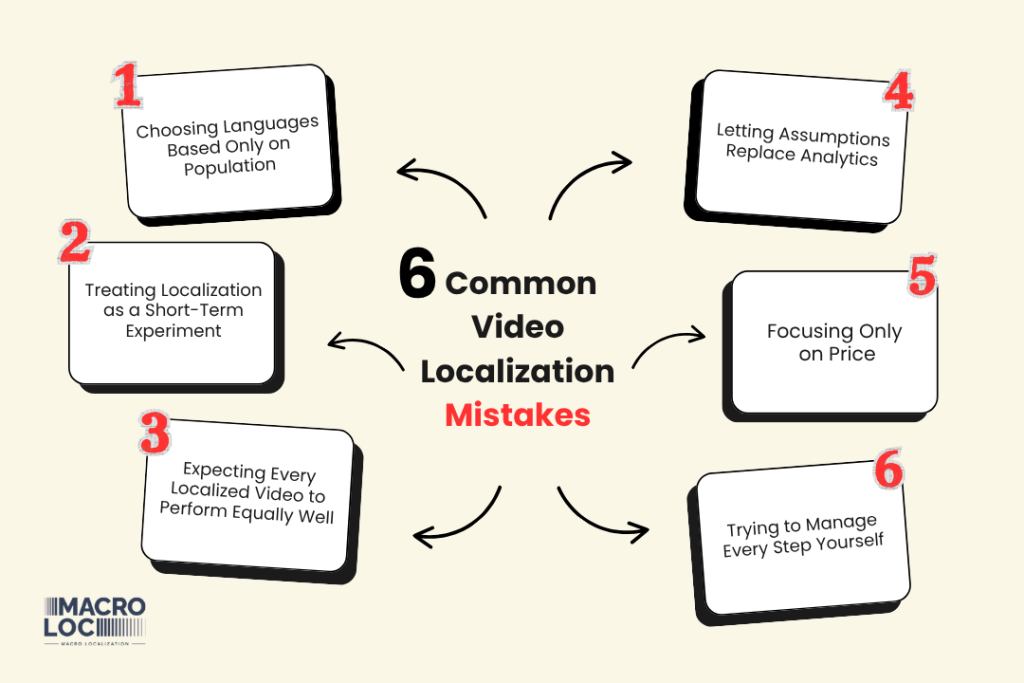
Chapter 12: Common Video Localization Mistakes
And How to Avoid Them
Video localization mistakes can reduce the impact of even the best content. Choosing the wrong language, focusing only on cost, ignoring analytics, or treating localization as simple translation can all limit international growth. Understanding these common mistakes helps creators make smarter decisions and maximize the long-term value of their localization efforts.
By now, you’ve seen that successful localization involves much more than translating a video into another language. It requires choosing the right audience, selecting the right localization method, preparing your content, and making strategic investment decisions. Even with the best intentions, however, many creators make avoidable mistakes that limit the impact of their localization efforts. Fortunately, most of these mistakes aren’t technical—they’re strategic, and they’re much easier to avoid once you recognize them.
Mistake #1 — Choosing Languages Based Only on Population
One of the most common assumptions is that the language with the largest number of speakers will automatically produce the largest audience. As we discussed earlier, international growth rarely works that way. Audience demand, analytics, content relevance, and market opportunity are usually much stronger indicators of success than population size alone. What to do instead: Let audience data guide your language selection instead of relying on global population rankings.
Mistake #2 — Treating Localization as a Short-Term Experiment
Many creators localize one or two videos, wait a few weeks, and then decide whether localization “works.” The problem isn’t expecting overnight success. Most experienced creators already understand that building an audience takes time. The real mistake is treating localization as a one-time experiment rather than an ongoing growth strategy. Just as building a successful YouTube channel requires consistency over months or years, expanding into international markets also requires commitment, continuous publishing, and learning from audience feedback and analytics.
What to do instead: Evaluate localization as a long-term strategy for international growth—not as a single campaign or experiment.
Mistake #3 — Expecting Every Localized Video to Perform Equally Well
Some creators expect every localized video to become an immediate success, but localization works much like content creation itself. Some videos naturally outperform others. Some topics resonate more strongly in certain markets. Some audiences take longer to discover a new channel. Judging your entire localization strategy based on the performance of one or two videos can lead to the wrong conclusions. Successful international channels improve over time by publishing consistently, studying audience behavior, and refining their strategy with each new release.
What to do instead: Evaluate localization across multiple videos and over a meaningful period of time rather than judging success based on a single release.
Mistake #4 — Letting Assumptions Replace Analytics
When creators first decide to expand internationally, it’s tempting to localize every video—or to choose videos based primarily on instinct. However, your audience is already providing valuable insights about where your greatest international opportunities may exist. Your analytics can reveal:
- Which videos already attract viewers from other countries
- Which topics resonate across different regions
- Audience retention
- Watch time
- Viewer engagement
- Comments requesting additional languages
- Which markets show the greatest growth potential
Instead of localizing your entire library or selecting videos based on assumptions, use this information to identify the content with the greatest international potential.Analytics should also play an important role in language selection. Existing viewer locations, watch time, engagement, and audience trends often provide far more reliable guidance than population statistics or personal intuition.
What to do instead: Let audience data guide both which videos you localize and which languages you prioritize.
Mistake #5 — Focusing Only on Price
Trying to reduce costs is perfectly understandable. However, choosing a localization provider based solely on the lowest quotation can sometimes become far more expensive in the long run. Poor localization may require revisions or complete rework, but the financial cost is often only part of the problem. More importantly, it can affect how international audiences perceive your brand.
An unnatural voice performance, inaccurate translation, awkward dialogue, or culturally inappropriate adaptation may reduce credibility and create a first impression that is difficult to change. Viewers rarely distinguish between the creator and the localization team. They simply judge the quality of the content they experience. A provider who understands your content, communicates clearly, and delivers consistent quality often creates far greater long-term value than the lowest initial price.
What to do instead: Evaluate quality, experience, communication, and workflow—not just price.
Mistake #6 — Trying to Manage Every Step Yourself
After learning about translation, dubbing, AI, recording, and quality assurance, some creators feel they need to oversee every technical detail of the localization process. Understanding how localization works is certainly valuable, but managing every production step yourself rarely improves the final result. Professional localization teams have established workflows, experienced specialists, and proven quality control processes designed to handle these technical aspects efficiently. Your role isn’t to become a localization expert. Your role is to remain the expert on your content, your audience, and your long-term vision.
What to do instead: Stay involved in the creative and strategic decisions, but let localization professionals manage the production process.
A Quick Pre-Launch Checklist
Before starting your next localization project, ask yourself:
✓ Am I choosing languages based on audience demand rather than population size?
✓ Am I treating localization as a long-term growth strategy?
✓ Have I reviewed my analytics before selecting videos and languages?
✓ Am I evaluating quality—not just price?
✓ Have I chosen a localization partner I trust?
✓ Am I measuring success over time rather than after one or two videos?
If you can confidently answer yes to these questions, you’re already avoiding many of the mistakes that prevent creators from succeeding internationally.
The Biggest Mistake of All: Confusing Localization with Translation
Perhaps the most fundamental mistake happens after the localized version is finished. It also explains why so many people misunderstand what professional localization is meant to achieve. Many creators evaluate the final result by comparing it line by line with the original script, expecting every sentence to match as closely as possible. However, successful localization isn’t about reproducing every word. It’s about recreating the same experience for a different audience.
That may require changing sentence structure, adapting humor, replacing cultural references, adjusting timing, or rewriting dialogue so it sounds natural in the target language. As a result, an excellent localized script may look very different from a literal translation while delivering a much better viewing experience. The real measure of quality isn’t whether every sentence matches the original. It’s whether viewers in another language understand the same ideas, experience the same emotions, and connect with the content in the same way as your original audience. Throughout this guide, we’ve returned to one central principle:
Your content isn’t simply being translated. It’s being localized. Those two concepts may sound similar, but they represent fundamentally different goals. When evaluating a localized video, don’t ask: “Is every sentence the same?” Instead, ask: “Does this version create the same experience for a new audience?” That question lies at the heart of successful localization. That’s the difference between translating content and truly localizing it. After learning what can go wrong, it’s equally valuable to study creators and media companies that have successfully expanded into international markets.
In the next chapter, we’ll examine real-world localization success stories and the practical lessons they offer for creators looking to grow their audiences worldwide.
Chapter 13: What Successful Global Creators Teach Us About Video Localization
Business Lessons from MrBeast, TED, Netflix, and More
Many of the world’s most successful creators and media companies use video localization as part of their international growth strategy. Although their budgets and production methods differ, they share common principles: focusing on audience experience, investing in quality, and treating localization as a long-term business decision rather than a one-time translation task.
Throughout this guide, we’ve explored the principles behind successful video localization—from choosing the right markets and localization methods to understanding production workflows, costs, and common mistakes but what do these principles look like when they’re applied by some of the world’s most successful content creators and media companies? Rather than focusing on their individual success stories, this chapter examines the business decisions behind their international growth. Although every creator follows a different path, many of the most successful global brands have reached remarkably similar conclusions about localization.
The scale of their operations may be very different from yours, but the principles behind their decisions are surprisingly universal. Their experiences offer valuable lessons for creators of every size.
How MrBeast Treats International Audiences
MrBeast’s international expansion demonstrates that successful localization is about much more than making content understandable. His videos are designed to deliver the same excitement, pacing, humor, and emotional impact regardless of the language in which they are watched. Rather than treating international audiences as secondary viewers, the goal has been to give them an experience that feels just as engaging as the original.
This approach also reflects a long-term commitment to international growth. Instead of viewing localization as an occasional production task, it became an integral part of the company’s global content strategy. As its multilingual audience expanded, localization grew into a strategic capability supported by dedicated resources and long-term investment.
An equally important lesson is that MrBeast didn’t simply translate content into one additional language. His international strategy expanded across multiple languages and markets, demonstrating that global growth is built systematically rather than one audience at a time. As channels grow, some organizations eventually build internal localization teams because the volume of content justifies the investment. For most creators, however, partnering with experienced localization providers remains the more practical and scalable solution.
What creators can learn
Successful international growth doesn’t begin by translating more videos. It begins by treating international audiences with the same level of care, quality, and commitment as your original audience.
How TED Removes Language Barriers
TED’s mission has always been to spread ideas as widely as possible. To achieve that goal, language could never become a barrier. Instead of relying on a single localization method, TED has combined professionally reviewed subtitles with contributions from a global community of volunteer translators. This flexible approach allows ideas to reach audiences in dozens of languages while maintaining quality and consistency. Unlike many commercial content creators, TED’s primary objective isn’t maximizing views—it’s maximizing accessibility. That philosophy shapes every localization decision it makes. Perhaps the most important lesson is that TED chooses the localization method that best serves its content and audience rather than applying the same solution everywhere.
What creators can learn
Successful localization isn’t about choosing the most advanced technology or the most expensive production method. It’s about choosing the approach that allows your audience to experience your content naturally.
How Netflix Makes Localization Feel Invisible
Netflix localizes thousands of hours of content every year across an extraordinary number of languages and cultures. At that scale, success depends on much more than translation. It requires standardized workflows, experienced creative professionals, quality assurance processes, cultural adaptation, and consistent production standards across every language. Those standardized workflows make it possible to deliver a consistent viewing experience across thousands of titles while maintaining quality at a global scale. Most viewers never notice these systems. Instead, they simply enjoy the story. Ironically, that’s exactly what great localization should accomplish. The less viewers think about the localization itself, the more successful it has probably been.
What creators can learn
Great localization rarely draws attention to itself. Its purpose is not to remind audiences that they’re watching translated content, but to allow them to become completely immersed in the viewing experience.
How YouTube Continues to Support Global Audiences
YouTube itself has increasingly recognized the importance of helping creators reach international audiences. Over the years, the platform has introduced features such as multilingual audio, translated titles and descriptions, and other localization tools that make it easier for creators to serve viewers in multiple languages. These features don’t replace professional localization, but they do demonstrate an important industry trend: reaching global audiences is no longer reserved for the largest media companies.
International growth has become an achievable strategy for creators of all sizes. Platform features can make localization more accessible, but they are most effective when combined with high-quality content and a well-planned localization strategy.
What creators can learn
Take advantage of the tools YouTube provides, but remember that technology works best when it’s combined with a thoughtful localization strategy.
Why Educational Content Travels So Well
Many of the world’s most successful educational creators have audiences that extend far beyond their home countries. The reason is surprisingly simple. Knowledge often addresses universal questions. Science, technology, business, personal development, history, and many educational topics remain valuable regardless of where viewers live. Localization removes the language barrier without changing the core value of the content. Educational content also tends to remain relevant for months or even years, giving localized versions more time to reach new audiences and generate long-term returns. The lesson isn’t that educational channels are automatically easier to localize. It’s that content built around universal value naturally has greater international potential.
What creators can learn
Before asking which language you should localize into, ask whether your content solves problems or answers questions that people everywhere share. The more universal the value, the greater the opportunity for international growth.
Why Entertainment Requires More Than Translation
Entertainment presents a very different challenge. Viewers aren’t simply consuming information. They’re responding to emotion, humor, storytelling, timing, character personalities, and cultural references. For that reason, entertainment often demands a higher level of creative adaptation than informational content. A joke may need to be rewritten. A cultural reference may need to change. Dialogue may need to sound completely different in another language while creating exactly the same emotional response. The objective isn’t linguistic accuracy. It’s emotional equivalence.
What creators can learn
Audiences rarely remember the exact words they heard. They remember how your content made them feel. Successful localization protects that experience—even when the words themselves need to change.
What We Can Learn at a Glance
Creator / Organization | Biggest Localization Lesson |
MrBeast | Treat international audiences with the same care and quality as your original audience. |
TED | Choose the localization method that best serves the content and the audience. |
Netflix | Build consistent workflows that make localization feel invisible. |
YouTube | Use platform features to make multilingual growth more accessible. |
Educational Creators | Universal value creates long-term global opportunities. |
Entertainment Creators | Protect the emotional experience—not just the words. |
What All Successful Global Creators Have in Common
Although these creators and companies work in different industries, produce different types of content, and serve different audiences, their international strategies reveal several common principles. They don’t treat localization as a simple translation task. They think about audience experience before language. They invest in consistency and quality rather than shortcuts. They make localization part of a long-term growth strategy instead of a one-time experiment and perhaps most importantly, they recognize that international audiences deserve the same level of attention and quality as viewers in their original market. The tools, budgets, and production methods may differ. The underlying principles remain remarkably consistent.
Bringing These Insights to Your Own Channel
You don’t need the resources of a global streaming platform or one of YouTube’s largest creators to apply these ideas. Whether you’re localizing your first video or expanding into multiple languages, the same principles still apply:
- Treat international audiences as an extension of your community—not as an afterthought.
- Choose localization methods based on the viewing experience you want to create.
- Invest in quality where it matters most.
- Build your international presence consistently over time.
- Focus on creating an authentic experience rather than a literal translation.
The scale of your business may be different. The principles behind successful localization remain exactly the same. You don’t have to copy the scale of successful global creators—you only need to apply the same principles at a scale that fits your own channel.
In the final chapter of this guide, we’ll bring everything together into a practical roadmap for planning, launching, and growing your own international localization strategy with confidence.
Chapter 14: Your Video Localization Roadmap
A Step-by-Step Plan for International Growth
A successful video localization strategy is built one step at a time. By evaluating your content, choosing the right markets, creating repeatable workflows, measuring results, and continuously improving, you can build a sustainable international growth strategy that expands your audience far beyond your original language.
You’ve reached the end of this guide—but hopefully the beginning of your international growth journey. Throughout the previous chapters, we’ve explored the principles of video localization, discussed the opportunities it creates, examined the challenges you may encounter, and looked at the strategies that successful creators use to reach audiences around the world. Now it’s time to turn those ideas into action. You don’t need to complete every stage perfectly before you begin. The roadmap is designed to help you move forward one step at a time.
Localization isn’t a one-time project. It’s an ongoing strategy that evolves as your channel grows. Some creators begin with a single language, while others launch several at once. Some start with subtitles, while others invest immediately in professional dubbing. There is no universal formula. However, there is a process that can help almost every creator make better decisions and reduce unnecessary risks. The roadmap in this chapter isn’t meant to be followed rigidly. Instead, think of it as a practical framework that you can adapt to your content, audience, and long-term goals.
Your Roadmap at a Glance
Stage | Focus |
1 | Evaluate Your Content |
2 | Define Your Goals |
3 | Choose Your First Market |
4 | Choose the Right Localization Method |
5 | Prepare a Repeatable Workflow |
6 | Launch Small and Learn |
7 | Measure What Matters |
8 | Optimize and Improve |
9 | Build the Right Partnerships |
10 | Scale with Confidence |
Stage 1: Evaluate Your Content
Before thinking about languages, translation methods, or production costs, take an honest look at your content. Ask yourself questions such as:
- Does my content have international appeal?
- Which videos continue attracting viewers months after publication?
- Are there countries already watching my content?
- Would viewers from another culture understand and enjoy these videos?
Not every video needs to be localized, and not every channel is equally suited for international expansion. Starting with the right content often has a greater impact than choosing the perfect language. Your goal at this stage is simple: identify the videos that have the greatest potential to succeed internationally.
Success looks like: ✓ You know which videos offer the strongest international potential.
Stage 2: Define Your Goals
Successful localization begins with clear objectives. What do you hope to achieve? Perhaps you want to:
- Reach new audiences.
- Increase watch time.
- Grow your subscriber base.
- Create new revenue opportunities.
- Build an international brand.
- Prepare your business for sponsorships or global partnerships.
Your goals will influence every decision that follows—from selecting target languages to choosing between subtitles, voice-over, or dubbing. Without clear goals, it’s difficult to measure success or know whether your localization strategy is working.
Success looks like: ✓ You have clearly defined what success means for your localization project.
Stage 3: Choose Your First Market
One of the biggest mistakes creators make is choosing languages based only on population size. Instead, focus on opportunity. Review your YouTube Analytics. Look for countries where viewers are already discovering your content. Consider your content niche, competition, audience behavior, and long-term business objectives. Sometimes a smaller market with strong engagement and less competition can produce better results than a much larger market. Start with one or two carefully selected languages. As you gain experience and collect data, expanding into additional markets becomes much easier.
Success looks like: ✓ You’ve selected your first target market based on evidence—not assumptions.
Stage 4: Choose the Right Localization Method
There is no single localization method that works for every creator. The right solution depends on your content, your audience, your publishing schedule, and your available budget. Some creators begin with subtitles. Others choose voice-over. Entertainment channels often benefit from professional dubbing, while many educational channels can achieve excellent results with simpler approaches. Modern AI tools have also made localization faster and more affordable than ever before. When combined with professional review and quality assurance, they can become an effective part of a scalable localization workflow. Choose the method that supports both your audience’s expectations and your long-term publishing strategy—not simply the lowest production cost.
Success looks like: ✓ You’ve chosen a localization approach that aligns with both your content and your long-term strategy.
Stage 5: Prepare a Repeatable Workflow
International growth becomes much easier when your production process is organized from the beginning. Prepare everything your localization team—or your future self—will need:
- Video masters
- Clean audio files
- Scripts or transcripts
- Subtitle files
- Graphics and editable assets
- Brand terminology and pronunciation guides
A well-organized workflow reduces production time, lowers costs, and makes it much easier to add new languages as your channel grows. Every minute spent organizing your assets today can save hours of work later. Remember, the goal isn’t just to localize one video. The goal is to build a system that can support hundreds of videos in the future.
Success looks like: ✓ Your production assets are organized and ready for efficient localization.
Stage 6: Launch Small and Learn
You don’t need to localize your entire library on day one. In fact, doing so often creates unnecessary risk. Instead, begin with a carefully selected group of videos—perhaps five to ten pieces of evergreen content alongside your newest releases. This approach allows you to build your international catalog while ensuring that new content continues reaching audiences in multiple languages. Most importantly, it gives you the opportunity to learn. Your first localization project isn’t a final test—it’s your first source of international audience data.
Pay attention to what works, what doesn’t, and how viewers respond. Every localized video provides valuable insights that will help shape your future strategy. Think of your first localization project as the beginning of a long-term learning process—not the final destination.
Success looks like: ✓ You’ve launched your first localized content and gathered meaningful feedback.
Stage 7: Measure What Matters
Once your localized content is live, resist the temptation to judge its success too quickly. International growth takes time. Audiences need time to discover your content, algorithms need time to understand who your videos are for, and you need enough data to make informed decisions. Don’t optimize too early. Give your audience—and the platform—time to respond before drawing conclusions. Rather than focusing only on view counts, evaluate your results from multiple perspectives, including:
- Watch time
- Audience retention
- Click-through rate (CTR)
- Subscriber growth
- Audience engagement
- Revenue
- Geographic performance
- Returning viewers
Most importantly, compare your results against the goals you defined at the beginning of your strategy. A localization project that successfully builds a new audience may be a success even if it doesn’t immediately generate millions of views. The purpose of measurement isn’t to prove that localization works. It’s to understand how you can make it work better.
Success looks like: ✓ You understand what’s working, what isn’t, and why.
Stage 8: Optimize and Improve
Every localization project teaches you something. Perhaps one language performs better than expected. Maybe viewers respond more positively to dubbing than subtitles. You may discover that certain topics resonate strongly with international audiences while others remain highly local. Use these insights to refine your strategy. Optimization may include:
- Testing new languages.
- Adjusting publishing schedules.
- Improving localized titles and thumbnails.
- Refining your localization workflow.
- Investing more heavily in high-performing markets.
- Experimenting with different localization methods.
Successful international creators don’t build their strategy once. They continuously improve it. Localization isn’t about correcting mistakes. It’s about continuously learning, adapting, and improving your international strategy.
Success looks like: ✓ Each localization project makes the next one more effective.
Stage 9: Build the Right Partnerships
As your international strategy grows, you’ll eventually reach a point where managing every aspect of localization yourself becomes increasingly difficult. Just as many successful creators work with editors, designers, producers, and managers, localization can also benefit from experienced professionals. A knowledgeable localization partner can help you:
- Evaluate whether your content is suitable for international audiences.
- Identify the markets and languages with the greatest growth potential.
- Recommend the most appropriate localization method for your content and budget.
- Design a workflow that balances quality, speed, and scalability.
- Avoid production mistakes that increase costs or reduce quality.
- Maintain consistency across multiple languages and publishing schedules.
Perhaps most importantly, an experienced partner can offer an outside perspective. Because they have worked with different types of content, industries, and international markets, they may identify opportunities—or potential challenges—that are difficult to see from inside your own business. Think of your localization partner the same way you would think about a trusted editor or producer. Their role shouldn’t simply be to complete production tasks. They should help you make better strategic decisions.
Some experienced localization companies may even be open to long-term partnerships with creators whose content shows strong international potential. Rather than simply providing a service, they may be willing to explore collaborative business models that align their success with yours. While this won’t be the right approach for every creator, it’s always worth having the conversation. The best partnerships aren’t built solely on production quality. They’re built on shared vision, trust, and long-term growth.
Success looks like: ✓ You’ve built relationships that support your growth—not just your production.
Stage 10: Scale with Confidence
Once you’ve established a workflow, identified successful markets, and built the right relationships, scaling becomes far more predictable. This is the stage where you can begin to:
- Add new languages.
- Expand your localized content library.
- Launch dedicated language channels where appropriate.
- Build local communities around your content.
- Adapt your metadata and marketing for different regions.
- Develop new revenue opportunities in international markets.
Growth doesn’t happen because you localize one successful video. It happens because you build a repeatable system that allows you to continue reaching new audiences, one project at a time. The creators who succeed internationally aren’t necessarily the ones with the biggest budgets. They’re the ones who consistently improve, learn from their audiences, and continue investing in quality over the long term.
Success looks like: ✓ Your localization strategy has become a sustainable engine for long-term international growth.
Final Thoughts
Every global creator started with a single audience. Every international brand began by speaking one language. Expanding beyond those boundaries didn’t happen overnight. It happened through a series of thoughtful decisions, continuous learning, and a willingness to invest in new opportunities. Video localization follows the same path. Your first localized video probably won’t transform your channel overnight, but it could become the first step toward reaching viewers you never imagined, building communities you never expected, and creating opportunities that simply weren’t possible before.
Throughout this guide, we’ve explored how successful localization is ultimately about creating the same experience for audiences in different languages—not simply translating words. When creators embrace that mindset, localization becomes much more than a production process. It becomes a strategy for sharing ideas across cultures, building stronger connections with audiences, and creating content that can truly travel the world.
One Final Thought
The world doesn’t need more videos. It needs more ideas that can cross borders. If your content has something meaningful to offer, don’t let language be the reason someone never discovers it. Your next audience may already be waiting. They just don’t speak your language yet and now, you have the roadmap to reach them.
Chapter 15: Video Localization FAQ
Answers to the Questions Content Creators Ask Most
Video localization raises many practical questions about costs, AI, YouTube features, workflows, language selection, and international growth. This FAQ brings together the questions content creators ask most often and provides concise, practical answers based on the principles discussed throughout this guide.
After reading this guide, you may still have a few practical questions about planning and managing your localization strategy. This chapter answers some of the questions content creators ask most often. While every channel is unique, these answers provide a practical starting point for making informed decisions becuase YouTube features, AI tools, and localization workflows continue to evolve, think of these answers as practical principles rather than fixed rules. You don’t need to read these questions in order. Jump to the ones most relevant to your channel, and come back whenever new questions arise.