
AI vs. Human Video Localization: When Do You Need a Human?
Table of Contents
AI can now handle tasks that would have seemed remarkably complex only a few years ago. It can transcribe speech, translate dialogue, generate subtitles, synthesize voices, clone speakers, and help synchronize localized audio with video. For creators and media teams, that makes multilingual production faster and more accessible than it once was, But the most useful question is no longer whether AI can participate in video localization. It already can. The harder question is how much of the process you should trust it to handle on its own.
The choice between AI vs. human video localization is therefore less binary than it first appears. Some projects can rely heavily on automation. Others benefit from AI efficiency but still need human review at important stages. And some depend so heavily on cultural judgment, creative adaptation, or performance that humans should remain in control of the most consequential decisions. The goal is not to use as much AI as possible, or to avoid it in the name of quality. It is to determine where automation creates meaningful efficiency and where human judgment still changes the outcome.
AI vs. Human Is Not Really a Binary Choice
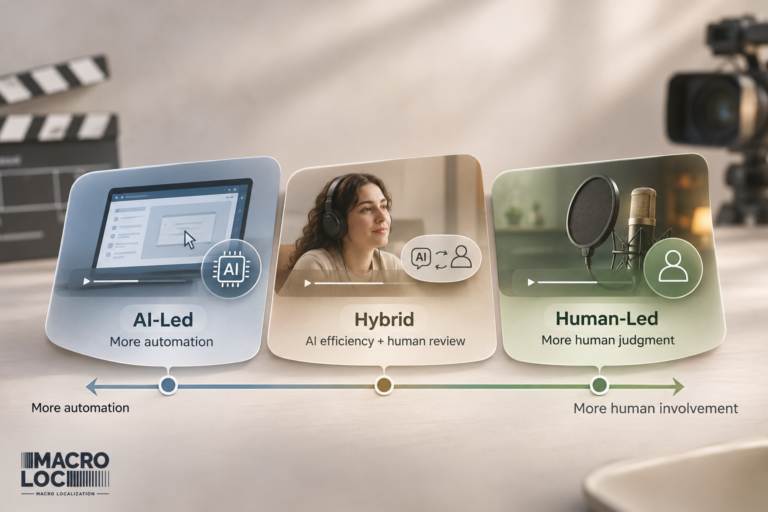
It is tempting to divide video localization into two camps: automated localization produced by AI and traditional localization produced by people. Modern production is rarely that simple. A more useful model is to think of localization as a spectrum of human involvement.
AI-led localization allows automation to handle most of the production, with limited human intervention. This can be appropriate for straightforward, repetitive, or lower-risk content where speed and scale matter and the consequences of an imperfect output are relatively small.
Hybrid localization, sometimes described as human-in-the-loop localization, uses AI for tasks where automation creates efficiency while reserving human attention for review, adaptation, performance, or quality decisions. The amount of human involvement can vary considerably from one project to another.
Human-led localization keeps people in control of the decisions that shape meaning and audience experience, while AI may still assist with repetitive or technical tasks behind the scenes. Human-led does not necessarily mean AI-free. This distinction matters because AI is not itself a localization strategy. It is a production capability that can be used differently depending on what the content requires.
If you are still deciding whether the video itself should use subtitles, voice-over, or dubbing, start with our guide to video localization methods such as subtitles, voice-over, and dubbing. Once the method is clear, you can make a separate decision about how much of that method should be produced or assisted by AI.
How Much Human Involvement Does Your Video Actually Need?
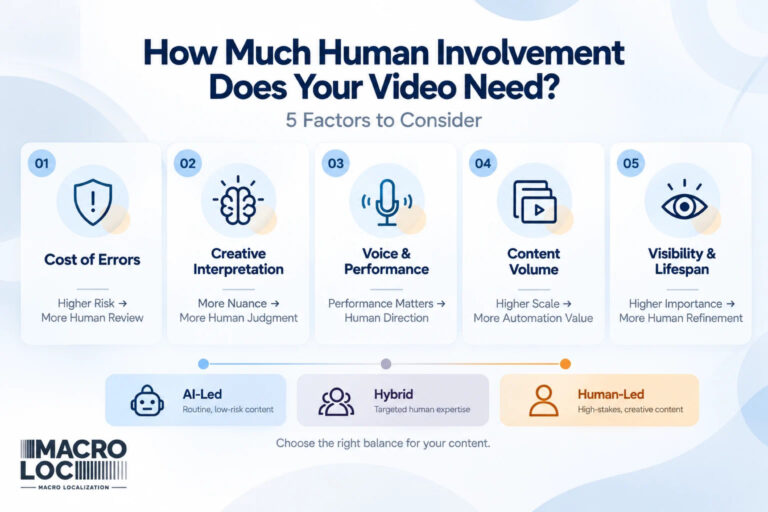
Instead of asking whether AI or humans are generally better at localization, evaluate the consequences and creative demands of the specific project. Five questions can help determine where a video belongs on the spectrum from AI-led to human-led localization.
1. How Costly Would a Mistake Be?
Not every localization error carries the same consequences. If an automatically translated internal training video contains an awkward sentence, the problem may be easy to identify and correct. If a high-profile product launch mistranslates an important claim, or a sensitive piece of communication changes the intended meaning, the consequences can be much greater.
This makes risk one of the most useful factors for determining the level of human involvement. Lower-risk content can often tolerate more automation, particularly when the information is straightforward and mistakes can be corrected easily. As the reputational, commercial, cultural, or informational consequences of an error increase, human review becomes more valuable.
The important distinction is that AI capability and acceptable risk are not the same thing. A system may be capable of producing a plausible translation, but the question for a business or creator is whether a plausible result is sufficient for that particular video. For higher-stakes content, the answer is often no.
2. How Much Meaning Depends on Interpretation?
Some videos mainly transfer information. Others depend on interpretation. A software tutorial explaining where to find a menu option has a relatively concrete communication goal. A comedy sketch, documentary interview, brand film, or emotionally driven story can contain layers of meaning that depend on tone, implication, humor, cultural references, timing, or the relationship between what is said and how it is said.
As meaning becomes less literal, human judgment becomes more important. AI-powered translation can process language quickly and can be particularly useful for first-pass translation, repetitive content, and material with predictable terminology. But localization sometimes requires deciding what an expression is trying to accomplish rather than simply determining what the words mean.
A joke may need to be recreated rather than translated literally. A marketing line may need to preserve persuasion instead of sentence structure. An idiom may require a completely different expression in the target language. A culturally specific reference may need judgment about whether the audience will understand it at all. A useful principle is: The more meaning depends on interpretation rather than information transfer, the stronger the case for human involvement.
That does not mean AI cannot contribute to creative content. It means the quality threshold should be based on whether the final meaning works for the audience, not merely whether a translation can be generated.
3. How Central Is the Speaker’s Voice or Performance?
AI dubbing and voice cloning have made it possible to reproduce aspects of a speaker’s voice in other languages at a scale that was previously difficult to achieve. For some types of content, that creates significant opportunities, but technical voice similarity is only one part of performance.
Consider a straightforward YouTube tutorial in which the creator’s primary role is to explain a process clearly. An AI-generated localized voice may be entirely appropriate if it sounds natural and communicates the information effectively. Now consider an emotional interview, a comedy performance, a dramatic scene, or a creator whose personality and delivery are central to why viewers watch. Small differences in timing, emphasis, emotion, rhythm, or intention can matter much more.
The useful question is therefore not simply: Can AI clone this voice?
It is: If the localized performance feels slightly less convincing than the original, how much does the video lose?
When the answer is “very little,” greater automation may be reasonable. When performance is part of the video’s value, human direction, adaptation, voice performance, or quality review deserves more weight. For projects where human performance is central to the localized experience, professional dubbing services can provide the linguistic and performance expertise required to recreate dialogue for the target audience.
4. How Much Content Do You Need to Localize?
Scale changes the economics of human attention. Localizing five flagship videos is a very different production challenge from localizing hundreds of software tutorials, training modules, product demonstrations, or knowledge-base videos. As volume increases, repetitive manual work can become expensive and slow, which is precisely where automation can create substantial value.
AI can assist with transcription, first-pass translation, subtitle generation, terminology consistency, synthetic voice production, and other repeatable tasks across large content libraries. Human attention can then be concentrated on the areas where review or adaptation adds the most value. This does not mean large volumes should automatically receive lower-quality localization. It means the workflow may need to become more selective about where human effort is applied.
Automation value rises with repetition and scale. The challenge is to use that efficiency without allowing volume to become an excuse for accepting errors or unnatural output that meaningfully affect the audience.
5. How Visible and Long-Lived Is the Content?
The expected life and visibility of a video can also influence how much human attention is worth investing in it. A temporary internal update, frequently replaced training video, or short-lived informational asset may not justify the same production process as a flagship brand video that will represent a company for several years. Likewise, a creator may treat a frequently updated informational series differently from a major evergreen production expected to attract viewers long after publication.
The more visible, strategically important, and long-lived the asset, the stronger the case for investing in careful review and refinement. That does not automatically mean every important video must be entirely human-produced. It means the tolerance for unnoticed errors, awkward language, cultural misjudgment, or unconvincing performance should become lower. AI can still create efficiency in high-value projects. Human attention simply becomes more selective and more deliberate.
A Human-Involvement Matrix for Video Localization
Instead of assigning every content category to either AI or humans, it is more useful to compare two underlying variables: the consequence of getting something wrong and the amount of creative interpretation required to get it right.
Lower Creative Dependency | Higher Creative Dependency | |
Lower Risk | AI-Led — automation may handle most stages | Hybrid — AI efficiency with human attention on creative elements |
Higher Risk | Hybrid / Human Review — automation can assist, but important outputs should be verified | Human-Led — human judgment should control the most consequential linguistic and creative decisions |
A large library of straightforward instructional videos may fall toward the AI-led side of the matrix because the communication is relatively factual and repetitive. A brand campaign involving humor, persuasion, and culturally sensitive messaging belongs much closer to the human-led side. Many projects sit between those extremes, which is exactly why hybrid localization has become so useful.
The matrix is a starting point rather than a universal rule. A video’s audience, language, distribution channel, quality expectations, and production constraints can all change the appropriate level of human involvement.
What AI Can Handle Without Owning the Final Decision
AI can contribute to many stages of video localization. Depending on the tools and workflow being used, those stages can include:
- Transcription
- First-pass translation
- Subtitle generation and timing assistance
- Terminology management and consistency checks
- Synthetic voice generation
- Voice cloning
- AI dubbing
- Lip-sync assistance
- Automated quality checks
- Repetitive workflow tasks
The ability to automate a task, however, does not automatically mean its output should be accepted without review.
The more useful question is whether the task requires generation or judgment.
Generating a transcript is a production task. Deciding whether a culturally specific expression should be rewritten for the target audience involves judgment. Producing a synthetic voice is a technical task. Deciding whether its performance preserves the intent of an emotional scene involves judgment.
AI localization tools are particularly valuable when they remove repetitive work and allow people to spend more time on decisions that genuinely benefit from human expertise.
The strongest workflow is therefore not necessarily the one that automates the largest number of tasks. It is the one that automates the right tasks.
Why Hybrid Localization Is More Than “AI + Human”
The term hybrid localization can sound as though AI completes half of the project and people complete the other half. In practice, hybrid workflows are much more flexible. Hybrid does not mean AI does half and humans do half. It means each task goes to the resource best suited to it.
For a large library of informational videos, AI might handle transcription, initial translation, subtitle timing, and terminology checks. Human reviewers could then focus on uncertain translations, important terminology, unnatural phrasing, and final quality assurance.
A creative project could use a very different hybrid model. AI might accelerate transcription and provide translation support, while human linguists adapt the script, performers deliver important dialogue, and human reviewers evaluate the final localized experience.
Another project might use human adaptation but AI-generated voices, followed by linguistic and audio quality review. The exact combination depends on what the project is trying to optimize. This is why “hybrid” should not be treated as a single production method. It is a way of allocating work.
When Should AI Output Trigger Human Review?
A scalable localization workflow does not necessarily require humans to inspect every automated output with the same level of attention. It does, however, need a way to recognize when human judgment is likely to matter. Human review becomes particularly valuable when the content includes:
- Ambiguous language with more than one plausible interpretation
- Humor, wordplay, idioms, or culturally specific references
- Brand-critical or persuasive messaging
- Sensitive or high-consequence claims
- Emotionally important dialogue
- Specialized terminology that must remain consistent
- Unusual names, acronyms, or contextual references
- Synthetic voices that sound unnatural or fail to match the intended performance
- Translation choices that are technically correct but feel unnatural in context
These are not simply examples of things AI may “get wrong.” They are situations where correctness itself can require judgment. A sentence can be grammatically accurate and still be wrong for the audience. A voice can pronounce every word correctly and still sound emotionally inappropriate. A translation can preserve the literal meaning while weakening a joke, brand message, or character.
A mature AI-assisted workflow therefore needs more than automation. It needs review triggers that direct human attention toward the parts of the project where that attention is most valuable.
Is AI Video Localization Always Cheaper?
AI can reduce the amount of manual production required for many localization tasks, particularly when content volume is high. That can make multilingual production faster and lower the cost of certain stages. But comparing AI and human localization purely on the initial production price can be misleading.
An automated output that requires extensive correction, repeated voice generation, translation revisions, synchronization fixes, or additional quality assurance can create costs later in the workflow. Tool subscriptions, processing fees, project management, and human review also remain part of the production equation.
The relevant comparison is therefore not simply the cost of generating the first output. It is the cost of producing a localized video that meets the required quality level.
Can AI Replace Human Translators in Video Localization?
AI can already replace or significantly reduce human work in particular localization tasks. That is different from saying that it can replace the need for human localization expertise across every project. This distinction matters.
Transcription can be automated. First-pass translation can often be automated. Subtitle timing can be assisted by software. Synthetic voices can be generated without a traditional recording session, and some repetitive quality checks can be performed automatically.
But a complete localization project can also involve interpreting context, resolving ambiguity, adapting cultural references, protecting terminology, evaluating performance, assessing audience expectations, and deciding whether the final result actually works.
In other words: Replacing tasks is not the same as replacing judgment.
For highly predictable informational content, the number of decisions requiring human judgment may become relatively small. For creative, sensitive, or high-value content, those decisions can be central to the success of the localized version.
The question “Can AI replace human translators?” therefore has no useful universal yes-or-no answer. A better question is which human tasks still change the quality or reduce the risk of this particular project.
What AI Localization Tools Cannot Decide for You
AI localization tools are becoming increasingly capable. They can translate, synthesize, clone, synchronize, automate, and analyze parts of multilingual production that once required much more manual work. What they cannot determine on their own is the business and creative standard the project needs to meet.
A tool does not decide whether an internal tutorial can tolerate a slightly awkward phrase. It does not decide whether a flagship brand video must sound completely natural in every target language. It does not determine how damaging a mistranslated claim would be, how important a creator’s personality is to the audience, or whether a particular cultural adaptation is worth additional production effort. Those are localization strategy decisions.
Technology can tell you what is possible. Your content, audience, risk tolerance, and quality expectations determine what is appropriate. That distinction will remain important even as the technology becomes more capable.
The Future of Video Localization Is More Selective Automation
AI will almost certainly continue to automate more parts of multilingual video production. Translation models will improve, synthetic voices will become more natural, voice cloning will become more convincing, and automated synchronization and quality checks will continue to develop. That does not necessarily point toward a future with no human involvement.
A more likely direction is more selective human involvement. As automation becomes reliable for routine tasks, human attention can move toward the decisions where interpretation, creativity, accountability, and performance have the greatest effect on the final result. Some projects may require very little intervention. Others may continue to depend heavily on human expertise even if AI supports the production behind the scenes.
The useful question will increasingly become not “Can AI do this?” but: Does this task still benefit enough from human judgment to justify human attention?
Choose Human Involvement Based on Consequence, Not Hype
The debate around AI vs. human video localization can easily become a debate about technology itself. For creators and organizations producing multilingual video, that is rarely the most productive way to make the decision.
AI is valuable when it reduces repetitive work, accelerates production, improves scalability, and allows multilingual content to be produced more efficiently. Human expertise becomes valuable when meaning depends on interpretation, mistakes carry meaningful consequences, performance matters to the audience, or the content is important enough to justify a higher level of refinement. Between those two ends of the spectrum lies a large range of hybrid workflows. The right approach is the one that applies automation where it creates genuine efficiency while directing human attention toward the moments where judgment still changes the outcome.
For the broader framework, from deciding what to localize to selecting methods, languages, workflows, and measurement strategies, see the complete video localization guide for content creators.