
Subtitles, Voice-Over, or Dubbing: Which Is Right for Your Video?
Table of Contents
Once you decide that a video is worth localizing, another decision quickly follows: how should people in the new market experience it? Choosing between video localization methods is not simply a matter of comparing subtitles, voice-over, and dubbing and selecting the most sophisticated option. Each method changes the relationship between the viewer, the original speaker, and the visuals. A method that works naturally for an interview may feel distracting in an animated series, while the approach that creates an immersive entertainment experience may be unnecessary for a straightforward tutorial.
The right choice therefore depends on what the video asks of its audience. You need to consider where viewers will direct their attention, how important the original voice is, how much immersion the content requires, what the target audience expects, and how much production effort is justified by the viewing experience you want to create. The goal is not to find one method that is universally better than the others. It is to find the method that asks the least of the viewer while preserving what matters most about the content.
The Three Main Video Localization Methods at a Glance
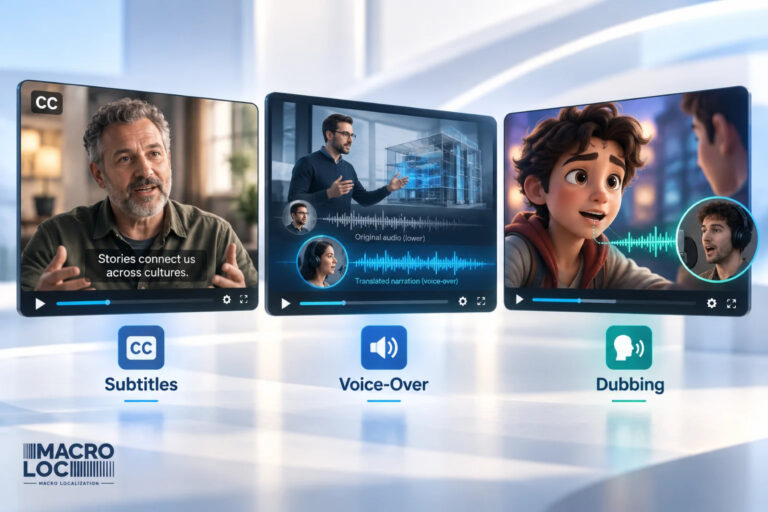
Subtitles, voice-over, and dubbing solve the same fundamental problem in different ways: they make spoken content understandable to an audience that uses another language. The difference lies in what the viewer sees and hears while that happens.
Localization Method | What the Viewer Experiences | Original Voice | Reading Required | Production Effort | Often Suited To |
Subtitles | Translated text appears while the original audio remains | Preserved | Yes | Lower | Tutorials, interviews, educational and informational content |
Voice-Over | Translated narration is heard while some connection to the original speaker remains | Partly preserved | No | Moderate | Documentaries, interviews, explainers, factual and corporate content |
Dubbing | Original dialogue is replaced by a performance in the target language | Replaced | No | Higher | Entertainment, animation, children’s content, narrative and character-driven video |
Subtitles generally interfere least with the original audio because the speaker’s voice and performance remain untouched. Voice-over shifts more of the experience into the target language while still allowing the original speaker to remain part of what the audience hears. Dubbing goes further by replacing the spoken performance and creating an experience designed to feel native to the target language. These differences are more useful than asking which method is “best.” The better question is which experience fits the video.
How to Choose Between Video Localization Methods
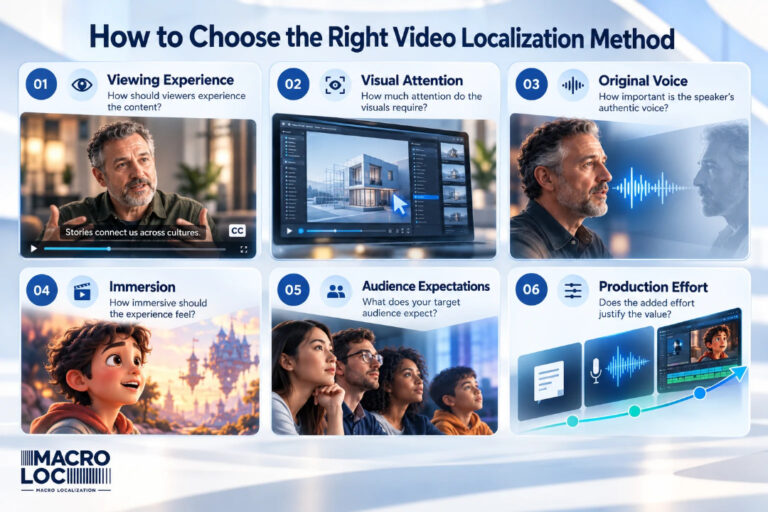
A common way to compare video localization methods is to begin with price or production complexity. Those considerations matter, but starting there can lead to the wrong decision. A less expensive method that makes a video difficult to follow is not necessarily efficient, just as a highly produced method does not automatically improve content that never needed that level of adaptation. A better approach is to work from the viewing experience outward. The following factors help reveal what the localized version actually needs.
1. Start With the Viewing Experience
Begin by imagining someone watching the localized video without knowing anything about how it was produced. Do you want that viewer to hear the original speaker and read the translation? Do you want them to understand the content through translated narration while still retaining some connection to the original voice? Or should the localized version feel as though the characters or speakers are communicating directly in the viewer’s language? Those are three different experiences.
Subtitles are often appropriate when preserving the original performance matters and reading does not significantly interfere with the content. Voice-over can work well when the audience should be able to listen in the target language without completely losing the presence of the original speaker. Dubbing becomes more compelling when the localized performance itself needs to carry the story, character, or emotional experience. This is why choosing a localization method should begin with the audience rather than the technology. The method is simply the mechanism used to create the experience.
2. Ask Where the Viewer’s Attention Needs to Be
Subtitles add another visual element to the screen, which means the viewer must divide some attention between reading and watching. In many videos, this is perfectly manageable. In others, it can become a meaningful constraint.
Consider a simple talking-head interview. The audience can often read subtitles without missing important visual information because relatively little is changing on screen. Now compare that with a software demonstration in which viewers need to follow menus, cursor movements, labels, and interface changes while also listening to an explanation. The viewer has considerably more visual information to process.
The same issue can arise in fast-paced entertainment, visually detailed documentaries, product demonstrations, instructional videos, or content containing substantial on-screen text. When the image itself carries a large part of the information, asking viewers to read continuously can compete with what they are supposed to be watching.
That does not automatically make dubbing the answer. Voice-over may provide enough listening accessibility without requiring a fully dubbed production. The key is to recognize visual attention as part of the decision rather than treating subtitles as a layer that can be added to every type of video with the same effect.
3. Decide How Important the Original Voice Is
The original speaker is sometimes more than a source of words. Their voice may contribute credibility, personality, emotion, or authenticity to the video. This is particularly relevant in interviews, testimonials, documentaries, expert commentary, founder-led videos, and other content built around real people. Completely replacing the speaker’s voice may change the relationship between that person and the audience, even when the translation itself is accurate.
Subtitles preserve that connection most directly because the original audio remains unchanged. Voice-over offers a middle ground: viewers can follow translated speech without relying on text while the original speaker can still remain audible as part of the experience.
Other types of content have different priorities. In animation, fictional storytelling, children’s programming, and character-driven entertainment, the original voice may be less important to the target audience than receiving a convincing performance in their own language. In those cases, dubbing can make more sense because the localized performance becomes part of the experience rather than merely a way to transmit information. A useful distinction is to ask whether the original voice is itself part of the video’s value. If it is, preserving it deserves greater weight in the decision.
4. Consider How Much Immersion the Content Needs
Not every video requires the same level of immersion. Someone watching a technical tutorial may be primarily interested in understanding the instructions. A viewer watching a drama, animated story, children’s program, or emotionally driven documentary is having a different experience. Attention to characters, pacing, visuals, and emotional continuity can be central to why the content works.
As the importance of uninterrupted visual and emotional attention increases, the case for localized audio often becomes stronger. Viewers who do not need to move continuously between subtitles and the image can focus more completely on the action and performance. This is one reason dubbing is frequently associated with narrative entertainment and children’s content. It allows the target-language performance to become part of the storytelling rather than an additional layer the viewer must interpret.
However, immersion should not be confused with production value for its own sake. A detailed dubbing production is not automatically an improvement if the audience values hearing the real speaker or if the content is primarily informational. The level of localization should support the way the content is consumed, not simply make the production more elaborate.
5. Account for Audience and Market Expectations
The same type of content may not be consumed in exactly the same way in every market. Audiences can have different levels of familiarity with subtitles, dubbing, and other forms of localized audio, and those expectations can influence whether a particular method feels natural.
This does not mean creators should choose a localization method based on stereotypes about a country or language. It means that method selection should happen in the context of the audience that will actually watch the content.
For example, a creator who already knows which international market they want to reach can investigate how comparable content is normally consumed there. Are viewers accustomed to subtitles for this type of video? Is localized audio common? Does the platform or format create particular expectations?
Those questions belong after identifying a promising market, not before it. Choosing where to localize and deciding how to localize are related decisions, but they are not the same decision.
6. Compare Production Effort With the Value of the Experience
Production effort matters because the three main methods generally require different levels of work. Subtitling involves translation, timing, formatting, and quality control, but it usually requires fewer production stages than localized audio. Voice-over adds recording, voice selection, audio production, and synchronization considerations. Professional dubbing can require translated and adapted dialogue, casting, performance direction, recording, synchronization, editing, mixing, and additional quality control depending on the project.
The important question is not simply which option costs less. It is whether the additional production effort creates enough value for the particular video and audience. A straightforward educational video may communicate perfectly well with subtitles, making a larger production unnecessary. A flagship entertainment series may depend so heavily on character performance and visual immersion that investing in dubbing becomes easier to justify. Between those examples are many projects where voice-over provides a practical balance.
Video Localization Method Decision Matrix
The factors above can be translated into a practical starting point. The table below is not a set of fixed rules; it is a way to identify which method deserves consideration first based on the experience you are trying to create.
If Your Priority Is… | Usually Consider First |
Preserve the original speaker or performance | Subtitles |
Keep production relatively simple | Subtitles |
Test accessibility in another language with a lower production commitment | Subtitles |
Reduce the need to read while retaining the original speaker’s presence | Voice-Over |
Let viewers concentrate on demonstrations or important visuals | Voice-Over or Dubbing |
Preserve authenticity in factual interviews while providing localized audio | Voice-Over |
Create a highly immersive target-language experience | Dubbing |
Localize narrative children’s content | Dubbing |
Make character performance central to the localized version | Dubbing |
The word “usually” matters. A documentary might use subtitles because preserving the original voices is essential, while another documentary might use voice-over because its audience needs to concentrate on archival footage and visual evidence. Two videos in the same category can therefore reach different decisions for perfectly valid reasons. The framework should guide the choice, not replace judgment.
Which Method Fits Different Types of Videos?
Content type is useful as a shortcut, but it should not become a rulebook. The strongest choice still depends on the characteristics of the individual video and the audience experience you want to preserve.
Tutorials and Educational Videos
Subtitles are often a practical option for educational material because they preserve the instructor’s original presentation and can make the content accessible without rebuilding the audio. They are particularly suitable when the visual material is relatively simple and viewers have enough time to read.
Voice-over becomes more attractive when viewers need to watch a detailed demonstration while following the explanation. Software tutorials, equipment demonstrations, and visually dense instructional content can place substantial demands on the viewer’s attention, so removing the need to read continuously may improve the experience.
Creators who decide subtitles are the right fit can explore professional subtitling services when accurate translation, timing, readability, and multilingual delivery need to be managed at production scale.
Interviews and Documentaries
Interviews and documentaries often place unusual importance on the original speaker. Their voice, hesitation, emotion, and manner of speaking can contribute to the credibility and humanity of the material.
Subtitles preserve that performance completely. Voice-over can provide easier listening while still allowing viewers to retain some sense of the person behind the translated words. The choice between the two often depends on whether authenticity or listening accessibility should receive greater weight. For projects where localized narration is the better fit, professional voice-over services can provide translated audio while supporting the tone and purpose of factual, educational, documentary, and corporate content.
Product Demos and Explainers
Product demonstrations and explainers can work with either subtitles or localized audio. The deciding factor is often visual complexity. If the presenter is speaking directly to camera and the graphics are simple, subtitles may be sufficient. If viewers need to follow product interfaces, diagrams, features, or physical demonstrations at the same time, voice-over can reduce competition for visual attention. The more the viewer needs to look at something other than the speaker, the more useful it becomes to ask whether reading should be part of the experience at all.
Children’s Content
Children’s content makes the limitations of one-size-fits-all localization particularly clear. Younger audiences may have limited reading ability, while character voices, songs, emotion, and storytelling can be central to engagement. For narrative children’s content, dubbing therefore has a strong practical case. It allows the story and characters to communicate directly in the target language without depending on reading ability. That does not mean every children’s video requires the same treatment. Educational content for older children may work differently from animated entertainment for preschool audiences. Age, format, learning objectives, and the role of character performance all influence the choice.
Entertainment and Character-Driven Content
As storytelling and performance become more central, dubbing generally becomes more relevant. Films, series, animation, scripted entertainment, and character-driven videos often depend on viewers staying engaged with the image, dialogue, pacing, and emotion at the same time. A strong dubbed performance can allow the localized version to deliver those elements through the target language rather than asking the viewer to divide attention between reading and watching.
For productions where that experience is the priority, professional dubbing services can support translated dialogue, voice performance, synchronization, and the broader audio experience required for a localized version.
Social and Short-Form Video
Short-form content is more context-dependent than it first appears. Some social videos are routinely consumed with limited or no sound, which can make subtitles or captions particularly useful. Other short-form videos depend heavily on personality, comedy, dialogue, or fast visual storytelling, making localized audio more relevant. Platform behavior, viewing environment, video length, visual density, and the importance of the creator’s original voice can all affect the decision. “Short-form” alone is therefore not enough to determine the right method.
You Don’t Have to Choose One Method for Everything
One of the most limiting assumptions in video localization is that a creator needs to select a single method and apply it across an entire channel or content library. In practice, different videos can justify different choices. A creator might use subtitles for tutorials, voice-over for documentary-style interviews, and dubbing for a narrative series. A media company could make similar distinctions between factual programming, children’s content, and entertainment rather than forcing every format into one localization workflow.
The choice can also evolve. A creator entering a new market may begin with subtitles for appropriate content and later decide that certain high-value productions justify localized audio. That does not make the earlier approach wrong; it means the localization strategy is changing as the content, audience, and level of investment change. In some cases, even the same video can be distributed with different localization options depending on platform capabilities, audience expectations, or market strategy. The objective is not consistency for its own sake. It is consistency of viewer experience: giving each audience an appropriate way to access the value of the content.
Method and Production Technology Are Different Decisions
The growth of AI-powered translation, speech generation, and video tools has made one distinction increasingly important.
Choosing a localization method and choosing how that method will be produced are separate decisions. Subtitles can be created through automated systems, human professionals, or a combination of both. Localized voices can also involve different production approaches. Deciding that dubbing is the right experience for a particular video does not, by itself, answer whether AI-generated voices, human voice actors, or a hybrid workflow should be used. The sequence matters because technology should not determine the audience experience before you understand what the content requires.
First ask: Should this video use subtitles, voice-over, or dubbing?
Then ask: What combination of technology and human expertise can produce that method at the quality, scale, and consistency the project requires?
Choosing the Right Experience for Your Audience
There is no universal winner among subtitles, voice-over, and dubbing because they are designed to solve different viewing problems. Subtitles make it possible to preserve the original voices while providing translated text. Voice-over can reduce the burden of reading without completely separating the viewer from the original speaker. Dubbing can create a more immersive target-language experience when performance, storytelling, or uninterrupted visual attention is central to the content.
The strongest decision comes from understanding what matters most in the original video and what the localized audience should be able to experience without unnecessary friction. That may be the speaker’s authenticity, the information on screen, the emotional flow of a story, the performance of a character, or simply the ability to follow an explanation comfortably.
If you are still deciding which content deserves localization in the first place, start with how to choose which videos to localize first.
For the broader strategy, including evaluating opportunities, selecting languages, choosing production approaches, and measuring results, see our complete video localization guide for content creators. The best localization method is ultimately the one that becomes least noticeable to the viewer because it allows the content itself to remain the focus.