
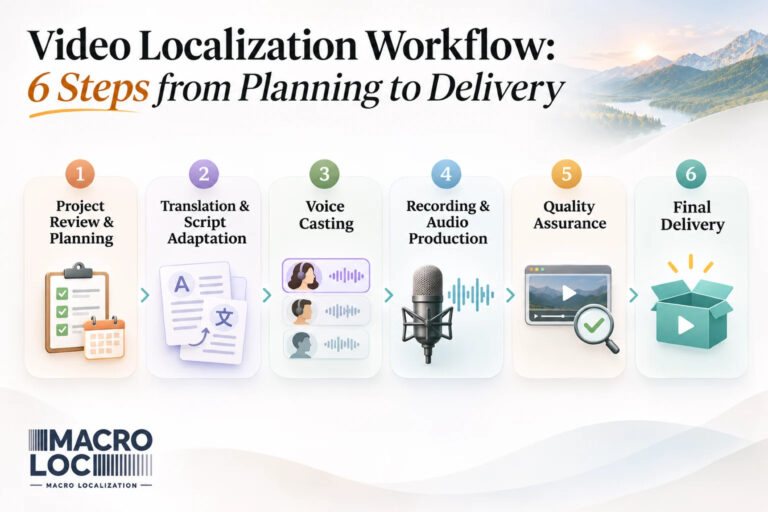
Video Localization Workflow: 6 Steps from Planning to Delivery
Table of Contents
You’ve decided to localize one of your YouTube videos into three new languages. You’ve chosen a localization provider, shared your content, and agreed on the localization method, but what happens after you hand over your video? A professional video localization workflow brings together translation, script adaptation, voice production, quality assurance, and technical delivery. Each activity helps transform your original video into a version that works for a new audience.
As a content creator, you don’t need to manage every production task. However, understanding the video localization process helps you know what happens behind the scenes, when your input is needed, and what you should expect to receive. Let’s follow an English-language documentary being localized into Spanish, French, and German to see how the process works.
How Does a Professional Video Localization Workflow Work?
A typical video localization workflow includes six main stages:
- Project review and planning: Reviewing the video, defining requirements, and organizing production.
- Translation and script adaptation: Preparing accurate, natural target-language content.
- Voice casting: Selecting suitable performers when dubbing or voice-over requires new voices.
- Recording and audio production: Recording, editing, synchronizing, and mixing localized speech.
- Quality assurance: Checking linguistic accuracy, audio, subtitles, visuals, and technical quality.
- Final delivery: Preparing approved files for publishing.
These video localization process steps provide a general framework, not a fixed sequence for every project. For example, a subtitle-only project doesn’t need voice casting or recording. Some activities can also happen simultaneously, especially when several languages are involved.
Step 1: Project Review and Planning
Every video localization workflow begins with understanding the project. For our documentary, the localization team reviews the finished video, available scripts, audio, graphics, and publishing requirements. They also identify details that could affect production, such as multiple speakers, technical terminology, cultural references, or on-screen text.
Defining the project scope
The project manager confirms the target languages, localization methods, expected deliverables, and approval requirements. For example, Spanish and French versions might require dubbing, while the German version only needs subtitles. These choices create different production paths. The team also checks whether the available source materials support the requested work. Missing audio tracks or editable graphics may require additional preparation, but they don’t automatically prevent localization. This stage establishes the scope and helps avoid misunderstandings later.
Typical output: A confirmed production plan, delivery requirements, and approval points.
Step 2: Translation and Script Adaptation
Translation is one of the most important stages in the video localization workflow, but accurate translation alone isn’t always enough. The localized script must preserve the original meaning while sounding natural to the intended audience. For our documentary, a translator may need to adapt idioms, technical expressions, or cultural references that wouldn’t make sense if translated word for word.
Preparing the script for production
Translation and adaptation often happen together, particularly in dubbing projects. Depending on the localization method, linguists consider different requirements:
- Subtitles: Readability, timing, and concise phrasing.
- Voice-over: Natural spoken language and suitable pacing.
- Dubbing: Speaking rhythm, synchronization, and lip-sync requirements when applicable.
The goal is to produce language that fits both the content and the way viewers will experience it.
How does the script move to the next stage?
Once the translation is prepared, the team checks terminology, pronunciation notes, and any unresolved questions. For example, if the documentary mentions a technical product name, the translator may need confirmation of its approved pronunciation before recording begins. The production-ready script is then shared with the recording team, together with relevant timing and performance instructions. This handoff matters because unclear wording or missing pronunciation guidance can lead to avoidable retakes.
Typical output: A production-ready translated script or timed subtitle text.
Step 3: Voice Casting for Dubbing and Voice-Over
When a project requires new voice performers, voice casting becomes part of the video localization workflow. The goal is to select voices that match the content’s tone, style, and intended audience. For a documentary, a calm and measured narrator may be more appropriate than a highly energetic performer.
How are voices selected?
Casting specialists consider vocal tone, speaking style, accent, perceived age, and suitability for the content. The localization provider may share several voice samples so the creator can compare performances before recording begins. Voice casting can sometimes start while translation is underway. However, the selected performer generally needs a production-ready script before final recording. A subtitle-only project skips this stage entirely.
Typical output: Approved voice talent and performance direction.
Step 4: Recording and Audio Production
Once the script and voice talent are ready, the video localization workflow moves into recording and audio production. Voice actors record the adapted dialogue, often with guidance from a director or recording specialist. Audio engineers then edit the recordings, adjust timing, remove unwanted noise, and prepare the localized speech for mixing.
Synchronization and sound mixing
For dubbing, the new dialogue must fit the relevant scenes and timing requirements. Voice-over may instead retain the original speech at a reduced level beneath the localized narration. Engineers balance the new dialogue with music, sound effects, and ambience to preserve the atmosphere of the original video. The technical requirements depend on the chosen localization method.
A practical example: When a translation doesn’t fit
Imagine that the French version of our documentary includes a sentence that takes noticeably longer to speak than the original English dialogue. During recording, the voice actor struggles to finish the sentence before the scene changes. The team doesn’t necessarily need to speed up the performance. Instead, the script adapter can revise the sentence to make it shorter while preserving its meaning. The revised line is then recorded and checked against the picture. This is a normal example of how translation, adaptation, recording, and synchronization may require several rounds of collaboration.
What happens in a subtitle-only workflow?
Subtitle production follows a different path. Instead of recording new dialogue, specialists divide the translated text into readable segments, synchronize it with the video, and check line breaks and display duration. The completed subtitles may be delivered as separate files or incorporated into the video, depending on the project.
Typical output: Edited localized audio, synchronized soundtracks, or timed subtitle files.
Step 5: Quality Assurance in the Video Localization Workflow
Quality assurance helps ensure that the localized version communicates accurately and works technically. Reviewers examine the finished video rather than relying only on the translated script.
What does quality assurance include?
Depending on the project, checks may cover:
- Language: Translation accuracy, terminology, and natural phrasing.
- Audio: Recording clarity, dialogue levels, and pronunciation.
- Synchronization: Dialogue timing and lip-sync when required.
- Subtitles: Timing, readability, and placement.
- Visuals: Localized graphics and on-screen text.
- Technical quality: File specifications and playback issues.
For example, a subtitle may be translated correctly but disappear too quickly for viewers to read. The subtitle specialist adjusts its timing, and the corrected version is reviewed again. Quality checks can also happen throughout production, not only at the end of the video localization workflow.
Typical output: Reviewed localized versions with identified issues corrected.
Step 6: Final Delivery in the Video Localization Workflow
After the required reviews and approvals, the localization team prepares the final files. The deliverables depend on the method and publishing platform.
Deliverable | Purpose |
Localized video files | Complete language-specific versions |
Subtitle files | Translated subtitles for supported platforms |
Localized audio tracks | Replacement narration or dialogue |
Caption files | Timed text prepared to the agreed requirements |
Localized graphics | Translated titles and on-screen elements |
Localized metadata | Translated publishing information, when included |
Not every project requires all these files. For our documentary, the creator might receive dubbed Spanish and French versions alongside German subtitle files. The team also checks that the delivered files meet the agreed technical specifications and are clearly labeled.
Typical output: Approved localization assets ready for the intended publishing workflow.
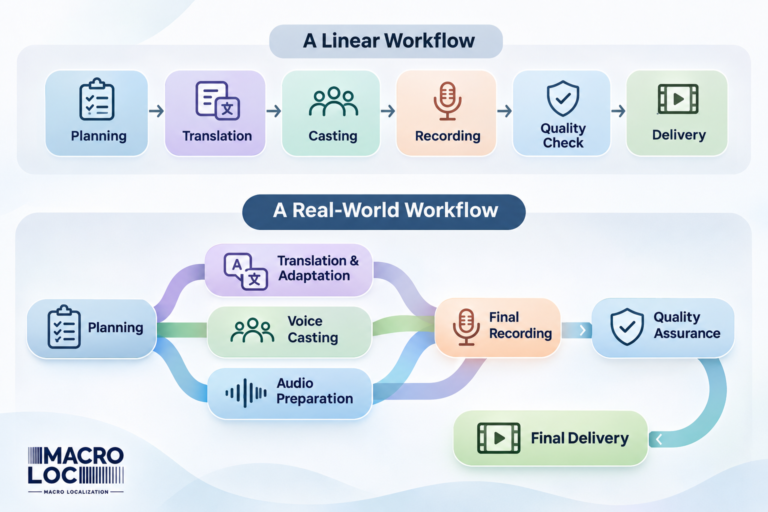
Why the Video Localization Workflow Isn’t Always Linear
Although we’ve described six stages, a professional video localization workflow rarely operates as a simple assembly line. Some tasks overlap. Translation for one language may be completed while another is still being reviewed. Voice casting can begin before all scripts are finalized. Audio preparation may happen while linguistic work continues. Other activities depend on earlier approvals. For example, final recording generally requires a production-ready script, and final delivery depends on completing the agreed quality checks.
Who coordinates these activities?
The project manager keeps translators, script adapters, voice actors, audio engineers, editors, and reviewers aligned. This coordination becomes particularly important when a project includes several target languages. The creator remains involved in important decisions without having to supervise every production task.
What Affects the Video Localization Workflow Timeline?
There is no universal timeline for every localization project. Two videos of the same length can require very different amounts of work. The main factors include:
Factor | Potential effect |
Video length | More content to translate, produce, and review |
Target languages | Additional language-specific tasks |
Localization method | Different requirements for subtitles, voice-over, and dubbing |
Number of speakers | More casting, recording, or editing work |
Script complexity | Additional research and adaptation |
Synchronization | More detailed timing and editing |
Source materials | Possible preparation or reconstruction work |
Approvals and revisions | Additional review cycles |
Some tasks can run in parallel, so adding languages doesn’t always increase production time proportionally. A realistic video localization timeline should be based on the actual project scope rather than a fixed estimate based only on video duration.
What Does the Creator Need to Approve?
Understanding the video localization workflow doesn’t mean you need to manage every stage. Your involvement is most useful when a decision requires knowledge of your content or creative goals.
Approval point | What you may review |
Project scope | Languages, methods, and deliverables |
Script and terminology | Important names, tone, and creative decisions |
Voice samples | Suitability of performers |
Final preview | Overall result before delivery |
Not every project requires all these approval points. The important thing is to provide feedback at the appropriate time. For example, if a proposed narrator doesn’t match your channel’s style, it’s better to raise the concern during casting than after the full recording is complete. Similarly, confirming technical terminology before recording can prevent unnecessary revisions. Clear communication helps the localization team maintain quality without creating avoidable delays.
A Professional Video Localization Workflow Makes the Process Manageable
A successful video localization workflow depends on coordination between linguistic, creative, and technical specialists. From the creator’s perspective, the process can remain relatively straightforward: provide the content, communicate your requirements, review important decisions, and receive the approved localized assets. For our documentary, the Spanish, French, and German versions may follow different production paths, but they share the same objective: communicating the original content clearly and naturally to new audiences. Understanding these six stages helps you approach localization with realistic expectations and collaborate more effectively with your production team. For a broader overview of planning and distributing multilingual content, explore our video localization guide for content creators.