
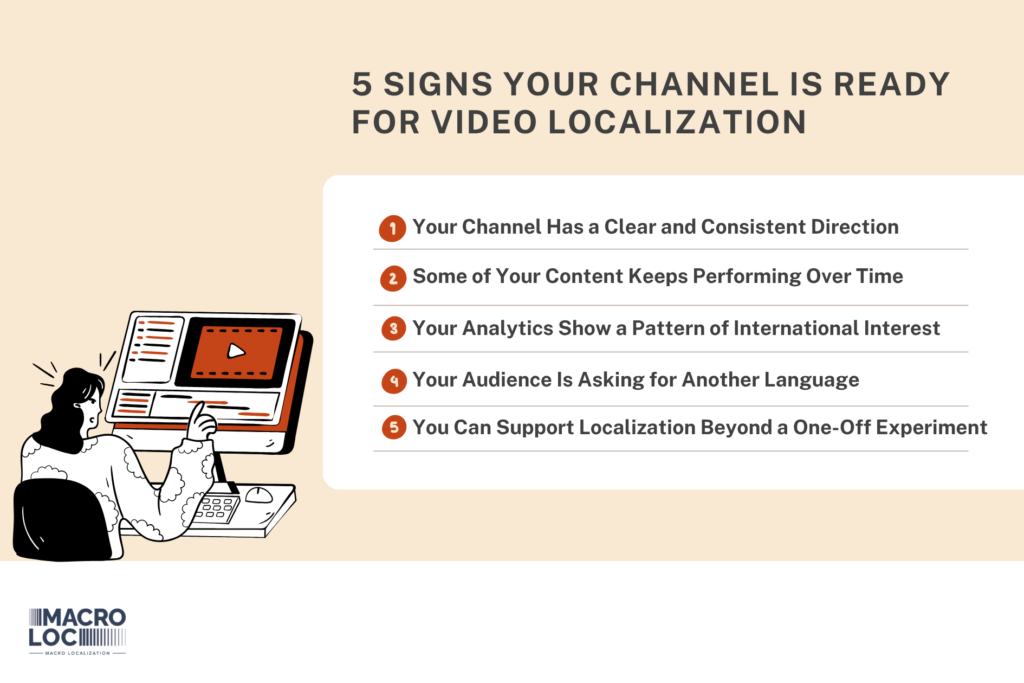
5 Signs Your Channel Is Ready for Video Localization
Table of Contents
Video localization can be a valuable next step for a creator, but only when the right signals are already there. Subscriber count alone won’t tell you whether your channel is ready. More useful evidence can come from your content library, audience behavior, international traffic, and the consistency of your publishing strategy.
So before choosing languages, localization methods, or individual videos, use these five signs as a practical video localization checklist to see whether the opportunity deserves a closer look.
First, Forget the Subscriber Threshold
There is no subscriber milestone that automatically makes a channel ready for localization. A smaller channel with several long-performing videos and recurring international viewers may show stronger localization potential than a much larger channel built around highly local or short-lived content. Total views can be equally misleading when most of them come from one unusual viral spike. Treat channel size as context, not a readiness test. What matters more is whether several independent signals point toward a genuine international opportunity.
1. Your Channel Has a Clear and Consistent Direction
Localization is easier to evaluate when you already understand what your channel does well and why viewers come to it. That does not require every video to cover the same subject or follow the same format. It simply means your channel has enough consistency for you to recognize which topics, formats, or series tend to connect with viewers.
If your content strategy is still changing dramatically from month to month, it may be difficult to know what exactly you are trying to expand internationally. Localization works better as an extension of a content strategy that is already taking shape than as an attempt to solve uncertainty about the original channel. A useful question to ask is:
Do I know what kind of content my audience consistently comes to me for?
If the answer is becoming clear, that is your first readiness signal.
2. Some of Your Content Keeps Performing Over Time
Next, look beyond your latest uploads. Some videos receive most of their attention shortly after publication and then quickly lose relevance. Others continue attracting viewers, answering questions, appearing in recommendations, or generating engagement months later. A channel with a meaningful library of this kind of content has more evidence to work with when considering localization.
Evergreen content is an obvious example, but the broader signal is proven staying power. A video that continues to create value has already demonstrated that its usefulness is not limited to its initial publication window.
This does not mean every long-performing video should be localized. At this stage, you are evaluating the channel, not selecting individual videos. The question is simply whether your content library contains assets that have already shown lasting value.
3. Your Analytics Show a Pattern of International Interest
Your audience may begin showing international potential before you intentionally target another language. For YouTube creators, audience geography is one useful place to look. The important thing is not simply whether international viewers appear in your analytics. You are looking for a pattern rather than an isolated event.
Start with persistence. Does international traffic continue over time, or did most of it arrive during one unusual spike? A temporary surge may come from an external share, a trend, or another one-off event and may tell you very little about long-term demand.
Then look across your content library. If one video attracts significant traffic from another country, that is worth investigating. If several related videos show similar international interest, the evidence becomes more meaningful because viewers may be responding to the underlying value of your content rather than one exceptional upload.
Finally, look for consistency in where that interest comes from. Are certain countries or regions appearing repeatedly, or is international traffic scattered without any recognizable pattern?
Together, these signals can help you distinguish a genuine audience pattern from an analytics anomaly. There is one important limitation, however:
Country is not the same as language demand.
A country may contain several major language communities, and some viewers may already be comfortable consuming content in your original language. Geography can tell you that international interest exists, but it cannot automatically tell you which language to target. Treat international traffic as evidence to investigate, not a language-selection shortcut.
4. Your Audience Is Asking for Another Language
Analytics tells you what viewers are doing. Sometimes viewers tell you directly what they need. You may see comments asking for subtitles in another language, requests for a dubbed or translated version, or viewers explaining that they would like to share the video with someone who does not understand the original language.
One request is not enough to justify a localization strategy. Repeated requests are more interesting, especially when they come from different viewers or consistently appear around the same types of content.
Pay attention to specificity as well. A vague comment from an international viewer tells you less than recurring requests for the same language or repeated feedback that language is making particular content difficult to use. These audience signals become especially useful when they support what you are already seeing in your analytics.
For example, recurring international traffic may suggest that a particular market is finding your content. Comments or language requests from viewers connected to that audience provide a different kind of evidence that helps you understand the pattern.
Neither signal guarantees that localization will perform well. But when what the data is telling you and what your audience is telling you begin to align, the case for investigating localization becomes stronger.
5. You Can Support Localization Beyond a One-Off Experiment
The final signal comes from your own publishing operation. Localizing one video can be an experiment. If that experiment works, however, you need to decide whether you can realistically build on it.
You do not need a large localization team or a complex international operation before you begin. But your original publishing process should be stable enough to accommodate another layer of work without undermining the content that created the opportunity in the first place.
Consider whether your source files are reasonably organized, whether you can identify content that deserves additional investment, and whether you could repeat the process for another video if the first localization effort proves worthwhile.
The question is not whether you already know how to manage every part of localization. Methods and workflows can be developed later. The readiness question is more basic: If localization shows promise, can I support it as more than a one-time experiment?
If the answer is yes, your channel has a stronger foundation for moving from curiosity to a deliberate localization strategy.
Video Localization Readiness Checklist
The five signals above can be reduced to a simple video localization checklist:
- ☐ My channel has a clear enough direction that I know what content consistently works.
- ☐ Some of my content continues creating value well after publication.
- ☐ My analytics show a recurring pattern of international interest rather than an isolated traffic spike.
- ☐ Viewers are giving me direct signals that another language could make some of my content more useful or accessible.
- ☐ My publishing process could support localization beyond a one-off experiment.
This is not a scorecard. Checking three boxes does not mean “wait,” and checking all five does not guarantee that localization will succeed. The purpose is to look for convergence. A single international comment, one successful evergreen video, or one unusual analytics spike provides limited evidence on its own. When several independent signals begin pointing toward the same opportunity, you have a stronger reason to investigate localization further.
What If Your Channel Isn’t Ready Yet?
If only one or two of these signals are present, localization may simply not be the next priority. A channel that is still changing direction frequently may benefit more from establishing a stronger content strategy first. If international traffic comes almost entirely from one temporary spike, it may be worth seeing whether the pattern repeats. And if you still do not know which content performs consistently over time, building a stronger library can give you better evidence for future decisions.
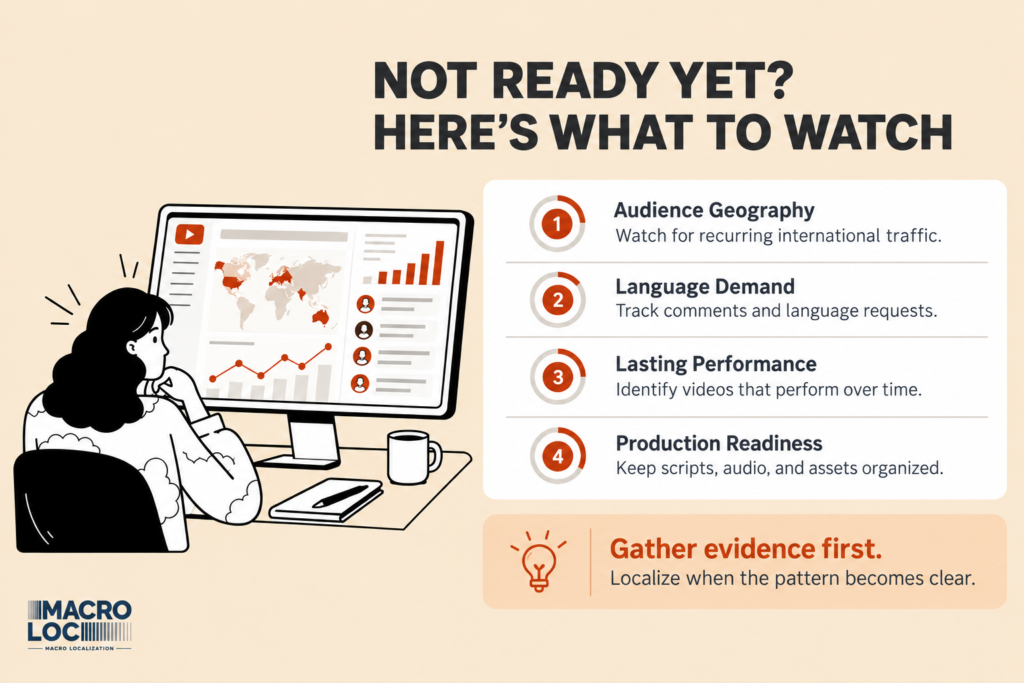
You can use this period to watch audience geography more closely, pay attention to language requests and international comments, identify videos with lasting performance, and improve how your production assets are organized.
The goal is not to wait for perfect conditions. Those may never exist. It is to make the decision with enough evidence that localization becomes a considered investment rather than a guess.
What Comes After Readiness?
Once several readiness signals begin to align, “Should I consider localization?” is no longer the most useful question. The next decisions become more specific.
- Which videos should I localize first?
- Which languages show the strongest opportunity?
- Should I use subtitles, voice-over, or dubbing?
These decisions should come after readiness because they require a more specific level of analysis. A promising international signal does not mean every video deserves localization, and international traffic from one country does not automatically identify the right target language.
For the broader strategy, including content evaluation, language selection, localization methods, production, quality control, and measurement, see our complete video localization guide for content creators.
If you are still evaluating the value of localization itself, our guide to the benefits of video localization for content creators explains what localization can add to an existing content strategy.