
How to Choose Which Videos to Localize First?
Once you have decided that video localization is worth exploring, the next challenge is how to choose videos to localize first. With dozens or hundreds of possible candidates in your content library, deciding where to start can be harder than it seems. The goal is not to localize everything at once or simply pick your most popular videos. It is to identify a small group where the opportunity justifies the effort, then use what you learn from those first choices to guide the next ones. That makes video selection less about finding a single “best” video and more about prioritizing the right videos at the right time.
How to Choose Videos to Localize From Your Candidate Pool
Before prioritizing videos, narrow the field. You do not need to repeatedly evaluate every upload on your channel. Start with videos that already have a reasonable case for localization based on factors such as demonstrated audience value, remaining useful life, relevance beyond the original market, or evidence of international interest. These are qualification signals, not yet a ranking. If you are still deciding whether your channel has enough evidence to consider localization in the first place, start with our video localization readiness checklist.
The complete video localization guide for content creators also covers the basic factors that can make individual videos stronger localization candidates.
For this stage, imagine that those questions have already helped you narrow a library of 50 videos to perhaps 8 or 10 plausible candidates. Now you have a different problem: Which of those candidates should move first?
How to Choose Videos to Localize Using Opportunity and Effort
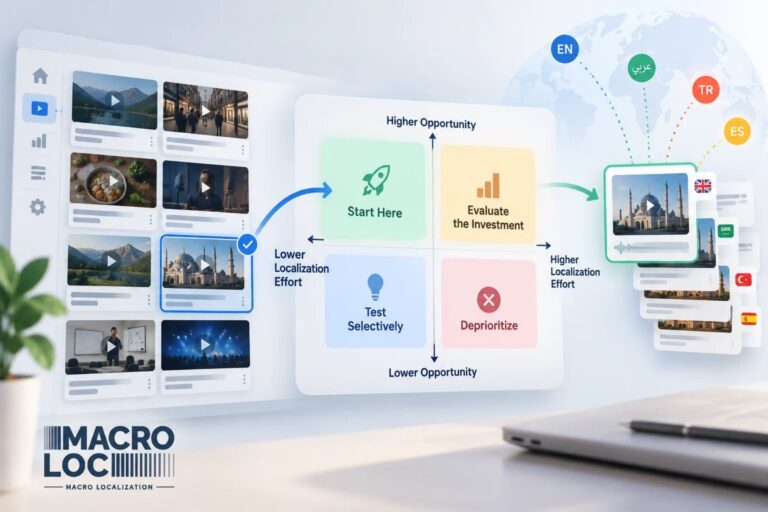
A useful way to compare localization candidates is to look at two dimensions together:
- Opportunity: How strong is the case that localizing this video could create additional value?
- Localization Effort: How much work will be required to produce an appropriate localized version?
Opportunity may be supported by existing performance, remaining shelf life, international relevance, audience signals, or a strategic reason to reach a particular market. Effort depends on the video itself. A relatively straightforward video may have clean dialogue and few visual elements requiring adaptation. A more complex production may contain extensive on-screen text, graphics, multiple speakers, culturally dependent examples, or other elements that require additional work.
Looking at these dimensions together creates four useful priority groups.
Opportunity Level | Lower Localization Effort | Higher Localization Effort |
Higher Opportunity | Start Here | Evaluate the Investment |
Lower Opportunity | Test Selectively | Deprioritize |
This is not a scoring system. Its purpose is to help you compare candidates and make the trade-offs visible.
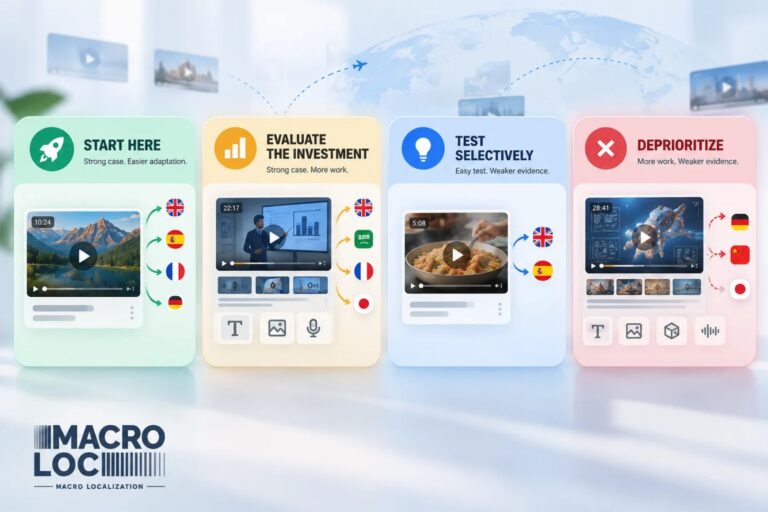
Higher Opportunity + Lower Effort: Start Here
These are usually the most natural first-wave candidates. The opportunity is already relatively strong, while localization appears manageable. Perhaps the video continues attracting viewers, its core value can travel across markets, and the production itself is straightforward to adapt.
Starting here gives you a chance to test localization without beginning with the most complicated project in your library. This does not mean “easy videos” should always come first. Ease only becomes valuable when the underlying opportunity is also credible. A video that is simple to localize but has little reason to reach another audience is still a weak candidate.
Higher Opportunity + Higher Effort: Evaluate the Investment
Some of your most promising videos may also be the hardest to localize. A video might contain extensive graphics, multiple speakers, embedded text, market-specific examples, or visual elements that require substantial adaptation. None of this means the video should be rejected. Instead, the higher effort needs to be justified by the opportunity.
This is where prioritization becomes more strategic. If the video addresses an important audience, has unusually strong international potential, or supports a broader market objective, the additional effort may make sense. If several easier candidates offer similar potential, however, the complex video may be better placed in a later wave. The key is not to confuse high localization effort with low localization value. They are different questions.
Lower Opportunity + Lower Effort: Test Selectively
Some videos are easy to localize but do not present a particularly strong opportunity. These can still have a role. A lower-effort video may provide a practical way to test a new language, production workflow, or audience assumption without committing to one of your most complex assets but low effort should not become the main reason to localize content.
If there is little evidence that the video can create additional value internationally, producing a localized version simply because it is easy may lead to a library of inexpensive content that few people need. Use these candidates selectively when they help answer a specific question.
Lower Opportunity + Higher Effort: Deprioritize
This is generally the weakest combination for an early localization investment. If the opportunity is uncertain and the video would also require significant adaptation, there is usually a stronger candidate elsewhere in the library.
Deprioritizing does not mean the video should never be localized. Circumstances can change. A new market opportunity, partnership, audience request, or business objective may later strengthen the case. It simply means that, based on what you know today, other videos deserve attention first.
What Should Break a Tie Between Two Videos?
The priority matrix will not always produce an obvious answer. Two videos may have similar performance, comparable international potential, and roughly the same localization complexity. When that happens, smaller differences can help determine which one should move first.
Choose the Video with More Useful Life Ahead
If two candidates are otherwise similar, the video likely to remain relevant longer usually gives localization more time to create value. A few extra months of useful life may matter when the localized version needs time to be published, discovered, and build an audience.
Look at the Quality of Your Source Assets
Production readiness can break a close tie. If one video has a clean script, accessible source audio, editable graphics, and well-organized project files while another requires significant reconstruction, the first may be a more practical starting point. This becomes especially relevant as localization moves into production, where the quality of source materials can affect both efficiency and consistency.
Prefer Clearer Market Evidence
Sometimes two videos look equally strong until you examine where their international interest comes from. If one candidate has a clearer connection to a particular international audience, it may give you a stronger basis for the next decision: which language or market to investigate. This does not mean geography alone determines language choice. It simply gives you more evidence to work with.
Consider What the Video Could Lead To
A video does not always need to be evaluated as an isolated asset. Suppose one candidate belongs to a group of related videos that could eventually form a useful localized series, while another is a standalone topic with little connection to the rest of your library.
If the opportunities are otherwise similar, the first video may create more strategic options. Strong performance could give you a logical path for deciding what to localize next, rather than leaving you with one successful localized video and no obvious follow-up. This is especially useful when you are trying to build an audience rather than simply generate additional views on a single asset.
Build a First Localization Wave, not a Permanent Ranking
Prioritization does not need to produce a fixed ranking of every video you have ever published. A more practical objective is to identify your first localization wave: a small set of videos that gives you a strong starting point and useful information for future decisions.
The obvious temptation is to select several videos that look almost identical from a localization perspective. But your first wave can be more informative when the candidates help you test different assumptions. For example, one video might have especially strong existing performance. Another may show clearer international interest. A third may offer slightly less proven demand but be much easier to adapt.
The purpose is not to create unnecessary variety. It is to avoid making your entire localization strategy depend on a single assumption. If every first-wave video is selected only because it has high historical views, poor results will tell you relatively little about why localization underperformed. A more deliberate group of candidates can help reveal whether audience signals, content longevity, international relevance, or production complexity actually matter for your channel.
Your first wave therefore has two jobs: create value and create information. Both can improve the decisions that follow.
Reprioritize as You Learn
Your first shortlist is based largely on evidence from the original versions of your videos. Once localized versions are published, you gain a new source of evidence: actual localized performance. That information can change your priorities. A video you considered a moderate opportunity may perform particularly well in another language. That result could strengthen the case for localizing related videos.
Another candidate may have looked excellent on paper but receive limited traction after localization. That does not necessarily mean the original selection framework was wrong, but it gives you a reason to reconsider similar candidates before automatically moving forward. Over time, your localization decisions can become less dependent on assumptions and more informed by your own results. This is another reason not to treat the initial shortlist as a permanent ranking.
The question evolves from: “Which videos look most promising?” to “What have our localized videos taught us about what to prioritize next?”
That feedback loop is where a one-time localization experiment can begin to develop into a more informed localization strategy.
Keep Video Selection Separate from Content Type, Language, and Method
Choosing the right video is only one part of the decision. A video can be a strong candidate without yet knowing which language should come first or whether subtitles, voice-over, or dubbing will be the most appropriate method. Keeping those decisions separate makes each one easier to evaluate.