

How to Choose Languages for Video Localization Based on Real Demand
Table of Contents
Suppose your YouTube channel gets 12% of its views from Brazil, 7% from India, and 4% from Germany. You have enough budget to localize your next batch of videos into one language. Which should you choose?
Brazil looks promising because viewers there are already finding your content. India offers access to a large and varied audience, although its geographic traffic tells you little about which language those viewers prefer. Germany accounts for fewer views, but those viewers might be watching longer or returning more often. You could choose Portuguese, Hindi, or German based on those numbers alone. You could also make an expensive mistake.
Learning how to choose languages for video localization requires more than checking which countries appear at the top of your analytics. You need to understand who is watching, whether your content suits the market, how much language is limiting the viewing experience, and whether the opportunity is worth pursuing. The best first language is the one supported by the strongest combination of evidence. Sometimes that will be a widely spoken language. Sometimes it will be a smaller language with a particularly interested audience.
Why the Most Spoken Language Isn’t Always Your Best Market
Lists of the world’s most spoken languages are easy to find. They can help you understand the potential scale of a language market, but they cannot tell you how many people in that market want to watch your videos.
A channel publishing English-language software tutorials, for example, has a different potential audience from a channel producing home renovation videos. Even when both channels consider the same language, the demand for their subjects, the available competing content, and viewers’ comfort with English may be quite different.
Spanish illustrates the problem. It is used across numerous countries, giving creators several potential markets to investigate. Yet a channel with little evidence of Spanish-speaking audience interest would have a weak reason to prioritize Spanish-language localization over a language associated with viewers who already watch its content regularly.
Population also says little about the size of the audience a creator can realistically reach. Internet access, platform habits, subject matter, and existing alternatives all affect that audience. A large language community may contain only a modest number of potential viewers for a specialized topic. This does not make population irrelevant. If two markets show similar demand, audience size may help distinguish their long-term potential. It is simply a poor starting point when more specific evidence is available.
Start With Markets, Then Identify the Languages
A common mistake in language selection is to treat a country as though it represents a single language. Imagine that YouTube Analytics shows an increase in views from Canada. That does not establish whether the viewers would prefer English or French. Traffic from India is even harder to interpret without additional evidence, given the country’s many language communities and the widespread use of English in some online contexts.
A country can contain several relevant language audiences. Equally, one language may connect viewers across countries with different cultural expectations. Arabic is a useful example. A creator considering Arabic localization may be interested in audiences in Egypt, Saudi Arabia, the United Arab Emirates, or several markets at once. Although these audiences share a written standard, preferences for spoken varieties and presentation can differ. A decision about Arabic should therefore include which audiences the videos are intended to serve and what form of Arabic will suit the content.
The same principle applies to Spanish across Latin America and Spain, or Portuguese in Brazil and Portugal. Before selecting a language, identify the market you hope to reach. Then ask which language or regional variety would make the content most accessible to the people in that market. This prevents an early geographic assumption from turning into a production decision.
How to Use YouTube Analytics for Language Selection
Your existing audience is a useful place to begin. People who already find your videos have demonstrated at least some interest in the subject, even if they currently watch in a language other than their preferred one. YouTube Analytics cannot identify the best target language automatically. It can, however, help you compare potential markets and recognize where further research is justified.
Identify countries already watching your videos
Start by examining geographic audience data in YouTube Studio. Look beyond the overall country rankings and check whether the same markets appear across several videos. A country that accounts for a large share of views because of one unusually successful upload may be less promising than a country that consistently contributes viewers across your content library.
For example, suppose Brazil accounts for 15% of your channel’s views. If most of those views came from one short video that circulated briefly, you have limited evidence of broader demand. If Brazilian viewers watch tutorials from several playlists and continue discovering older uploads, the pattern is more encouraging. The distinction matters when you are deciding whether to invest in a language that could serve more than one video.
Compare watch time and engagement across markets
View counts provide an incomplete picture. A country may send plenty of visitors who leave quickly, while another contributes fewer viewers who spend considerably more time with your content. Compare the available watch-time and engagement data for your candidate markets. Average view duration, retention patterns, and repeat engagement can help you understand whether people are finding the content useful.
Interpret these metrics in context. A short video will naturally produce different watch-time figures from a 40-minute tutorial. Comparing countries across videos with different lengths and subjects can lead to misleading conclusions. Where possible, examine similar videos over comparable periods. You are looking for a pattern of interest that extends beyond an isolated spike.
Look for language requests and audience clues
Comments can provide evidence that geographic data cannot. A viewer asking for Portuguese subtitles is telling you something more specific than a view from Brazil. Repeated requests for a language across different videos deserve attention, particularly when they come from viewers who already engage with the channel.
You may also notice questions about whether videos are available in another language, comments describing difficulty following the narration, or discussions among viewers in a language different from the video’s original audio.
These clues are useful, but they need context. A handful of enthusiastic comments does not necessarily represent a large audience. Nor does the absence of language requests mean viewers have no difficulty with the original language. Treat comments as supporting evidence, especially when they reinforce patterns visible elsewhere.
Understand what analytics cannot tell you
Geographic data reveals where views originate. It does not reliably establish the language each viewer would choose for a localized version. Traffic from India, for instance, is not enough to justify producing Hindi-language content. Those viewers may prefer Hindi, English, or another language, and the answer may vary by subject and audience.
Analytics also cannot tell you how many people are interested in your topic but never discover your videos because they search, browse, or watch primarily in another language. That creates an important limitation: your current audience data is evidence of existing interest, while the audience you have not yet reached remains partly unknown. Use analytics to develop and compare language hypotheses. Do not expect it to settle every question.
Look Beyond Your Channel: Is There a Market for Your Content?
A language may look promising in your analytics but offer limited room for further growth. Another may generate relatively few current views while having a substantial audience interested in your niche. This is where external market research becomes useful.
Start with the subject of your videos. If you publish tutorials about a particular software product, investigate whether that product is commonly used in the markets you are considering. A large audience for technology content in general does not guarantee demand for that software.
For educational videos, consider whether the topics match local learning needs. For product demonstrations, look at whether the product is sold or accessible in the market. For entertainment, examine the kinds of videos that viewers already watch and the expectations surrounding language and presentation.
Search for comparable content in the target language. YouTube search results, relevant channels, audience discussions, and other publicly available material can help you understand the market. Pay attention to the questions competing videos answer, how recently they were published, and whether audiences continue engaging with them.
Competition requires careful interpretation. A market crowded with established creators may be difficult to enter, but it also demonstrates that an audience exists. A market with almost no comparable videos could represent an underserved opportunity or simply weak demand. The absence of competitors is not proof of an opening.
For a deeper explanation of the characteristics that allow certain subjects and formats to work across markets, see what makes video content work across cultures and markets.
How to Choose Languages for Video Localization: A Practical Framework
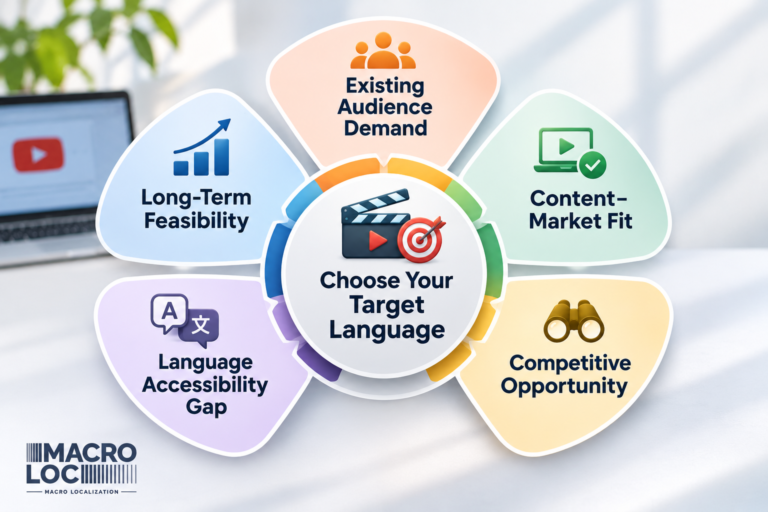
Once you have identified a few candidate languages, compare them using the same criteria. Five factors provide a practical starting point.
1. Evidence of existing audience demand
Look for consistent viewing activity from relevant markets, meaningful watch time, repeat engagement, and language requests. Existing demand reduces uncertainty because people have already shown an interest in your content. It does not guarantee that a localized version will perform better, but it gives you a more concrete starting point than population estimates. Consider how strong the evidence is and how much of your content it covers. A recurring audience across several videos is generally more informative than a single viral result.
2. Content-market fit
Ask whether the subject of your videos is relevant to people in the market. A tutorial about a widely used application may have broad appeal, while one about a country-specific tax process may have little relevance outside its original market. A video featuring a product unavailable in the target country faces a similar limitation.
You should also consider whether examples, terminology, and references will make sense to the audience. A video can be translated accurately and still offer limited practical value in another market. That problem cannot be solved by choosing a more widely spoken language.
3. Competitive opportunity
Examine the content already available in the target language. Are viewers finding recent, useful videos on the same subject? Do established channels cover the topic thoroughly, or are there gaps in the information they provide? Can your content offer something distinctive?
Avoid reducing competition to a simple count of channels. A market with many weak or outdated tutorials may still be attractive. Conversely, a market with only a few excellent creators could be difficult to enter if those creators already meet most audience needs. The question is whether your videos have a credible reason to be watched alongside the existing alternatives.
4. Language accessibility gap
This factor is easy to overlook. An audience may be interested in your topic and already comfortable watching it in English. In that case, producing a localized version might improve the experience, but the language barrier may be smaller than you assumed.
Another audience may struggle with fast narration, specialized terminology, or content that requires close attention to spoken instructions. Localization could make a more noticeable difference for those viewers.
Look for direct language requests, comments about comprehension, and differences in engagement that might be associated with language difficulty. Where possible, test your assumptions with actual viewers.
Be careful about drawing conclusions from national English-proficiency rankings or broad stereotypes. Language comfort varies substantially within countries and across subjects. The question is how much a localized version would improve access to your particular content.
5. Long-term feasibility
A promising language is more useful when you can support it beyond one isolated release. Consider whether suitable language expertise is available, whether the content will require substantial cultural adaptation, and whether you can maintain terminology and quality across future videos. For a creator producing weekly tutorials, the ability to localize new uploads consistently may matter more than achieving an elaborate production for a single release.
Feasibility also includes your broader goals. A market with strong audience interest may be attractive even if it offers limited direct revenue. For a business using video to support customers or product adoption, the relationship between audience demand and commercial opportunity may carry more weight.
Decide which outcomes matter to your project before comparing markets. Otherwise, it becomes too easy to favor whichever language happens to have the most impressive-looking statistic.
Compare Your Shortlisted Languages Before Choosing One
Consider a hypothetical English-language YouTube channel that publishes software tutorials. Its creator is evaluating Portuguese for Brazil, German for Germany, and Indonesian for Indonesia. The following ratings are invented for illustration. They are not assessments of the actual markets or predictions of how localization would perform.
Evaluation factor | Portuguese (Brazil) | German (Germany) | Indonesian (Indonesia) |
Existing audience demand | Strong | Moderate | Moderate |
Content-market fit | Strong | Strong | Moderate |
Competitive opportunity | Moderate | Moderate | Strong |
Language accessibility gap | Strong | Moderate | Unknown |
Long-term feasibility | Strong | Strong | Moderate |
- Portuguese appears to be the most defensible first choice in this example. It has strong evidence of existing interest, the subject fits the market, and the creator believes language is limiting access to the videos.
- German remains a reasonable candidate. Its content-market fit and production feasibility are strong, although the available evidence suggests a smaller immediate opportunity.
- Indonesian presents a different situation. Competition appears favorable, but the creator has less evidence about whether language is actually preventing interested viewers from engaging with the content.
That unknown matters. It is a reason to investigate further, not automatically a reason to reject the language. This comparison works best when each rating has an explanation behind it. Write down what supports a Strong or Moderate assessment, where the information came from, and which assumptions remain untested.
You do not need to convert every factor into a numerical score. A score such as 83 out of 100 can suggest more precision than the evidence deserves, especially when some inputs come from incomplete audience data or subjective market research. The purpose of the comparison is to make the decision easier to explain and revisit.
If two languages remain close, identify what additional evidence would help you distinguish them. A small test, direct audience feedback, or more focused competitor research may be more useful than spending another week comparing population figures.
What If You Have Little or No International Audience Data?
Not every channel has enough international traffic to identify a clear language opportunity. A newer creator might have only a few hundred views from outside the original market. A channel with a narrow domestic audience may have almost no geographic evidence to work with. In that situation, begin with the content rather than forcing conclusions from small numbers.
Identify markets where the subject is likely to be relevant. Investigate comparable channels and videos in the local language, look for recurring audience questions, and consider whether the content depends on products, services, or circumstances specific to one country.
You can also gather direct feedback from potential viewers. Even a small number of informed responses may reveal problems with your assumptions about language preferences or topic relevance. Keep the initial commitment proportionate to the uncertainty. You may have enough evidence to test one language, but not enough to justify localizing an entire content library.
This is different from assessing whether your channel is ready for a multilingual expansion. Our video localization readiness checklist covers that earlier decision. Here, the task is to choose the most plausible language when the available evidence is incomplete. A lack of data does not prevent you from making a decision. It means you should be more cautious about how much confidence you place in it.
Choose One Language First, Then Validate the Decision
After comparing your options, choose a language with a clear reason behind it. For example, your decision might be: We will test Brazilian Portuguese because viewers in Brazil consistently watch our tutorials, the software is relevant to that market, and several audience comments suggest that Portuguese narration would be useful. That is a testable hypothesis. It identifies the audience, the expected benefit, and the evidence supporting the choice.
Start with a manageable selection of videos that represents the content you expect to continue producing. Avoid selecting an unusually successful video simply because it is your biggest hit; its performance may be difficult to reproduce in any language.
If you still need to decide which individual videos deserve attention first, our guide on how to choose videos to localize covers that separate decision.
Once the localized videos are available, examine how viewers respond. Compare performance with your expectations and consider the limits of the comparison. Differences in release timing, promotion, topic, and distribution can affect results independently of language.
You may find that the localized version attracts new viewers who rarely watched the original language. You may discover that engagement improves among an existing audience. Or you may learn that the expected language barrier was smaller than your research suggested. All three outcomes provide information for your next decision.
You do not have to choose every future target language at the beginning. Selecting one credible opportunity, learning from it, and expanding with better evidence is often more manageable than committing to several markets before understanding how the first one performs.
The Best First Language Depends on Your Audience
There is no fixed list of languages that every video creator should prioritize. A language with hundreds of millions of speakers may offer little immediate opportunity for a specialized channel. A smaller market may contain viewers who already search for the subject, follow similar creators, and would benefit from a version they can understand more comfortably.
Your analytics can help identify those viewers, but geographic traffic needs interpretation. External research can reveal opportunities beyond your existing audience, although it introduces more uncertainty. Comparing both sources against the same criteria gives you a stronger basis for choosing where to invest.
Before committing to a target language, make sure you can explain who the intended audience is, why the content suits that market, and what evidence suggests localization would improve access to it. For more on how language selection fits into a broader international content plan, read our complete video localization guide for content creators.